Who Is Cheating?

Laboratory samplesA new test is in development to try to identify athletes who use a certain banned substance to enhance their performance.

The development team has accumulated data which indicates that although the test shows good results in detecting an athlete who has used this substance, the false positive rate is more worrying.
 
What is the probability that an athlete who is not taking the substance tests positive?
What is the probability that an athlete who is taking the substance tests negative?

You are going to investigate this question through a practical experiment.
You will need a die with four sides one colour (blue) and two a different colour (red), two ordinary numbered dice, and some red, blue, green and yellow multi-link cubes.  (If you do not have a die with sides in two colours, use a numbered die and designate 1, 2, 3 and 4 to be blue and 5, 6 to be red).

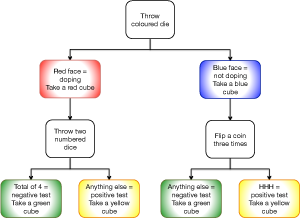
flow chart of simulation rulesFirst use the flow chart to investigate what happens for one athlete (click here for a full size version or click here for a written version).

Stick your two cubes together.

What do each of these mean?
Now repeat the experiment 36 times in total, so that you have 36 pairs of cubes.

Are you surprised by your results?

How do they compare with what we would expect?  
This worksheet will help you to work out the expected results.  You need to be sure that you have correctly identified how many possible outcomes there at each stage, and how many of those give each result - this Sample Space worksheet will help you with that.

In what proportion of the 36 trials do athletes who are not taking the banned substance test positive?

Given that an athlete is not taking the banned substance, what is the probability that they test positive?  (What figure should go in the denominator here?)

In what proportion of the 36 trials do athletes who are taking the banned substance test negative?

Given that an athlete is taking the banned substance, what is the probability that the test is negative?  (What figure should go in the denominator here?)

This worksheet will help you to interpret the expected results as probabilities, leading to a general result for probability trees - the multiplication rule.

Extension questions


Once you have your probability tree and 2-way table, have a go at these questions:
Can you suggest other questions along these lines that you can now answer?


Rules for the simulation:

  1. Throw the coloured die.
  2. If the athlete is taking a banned substance (you have a red cube), throw two numbered dice.
  3. If the athlete is not taking a banned substance (you have a blue cube), flip a coin three times.