Early Fraction Development
EARLY WORK ON THE DEVELOPMENT OF THE CONCEPT OF FRACTIONS.
Let’s start by the sharing into 2 parts, first of all let me describe an activity I have used many times and find to be quite successful.
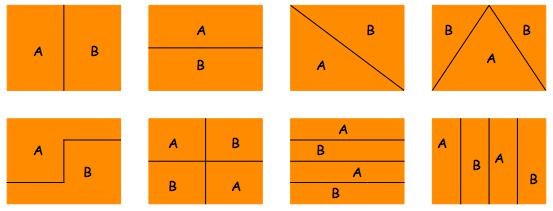
I have often started by presenting the pupils with A4 sheets of paper and encouraging them to half each piece in different ways.
If the pupils are sitting in groups of 4 or 5 then I would set them the challenge of producing 4 or 5 different ways of halving.
They would have to be able to say why they know that each pair of halves is equal.
If you try this you may get examples like these where A and B show the halves whether they are single or separate parts.
With some pupils you may only have the first three above shown as examples. For these pupils more experiences will be probably worthwhile.
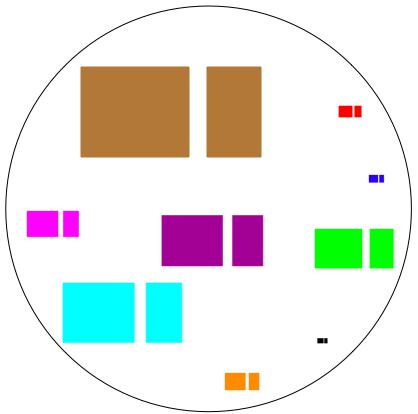
When that had been thoroughly explored and talked about I went on to other sizes of paper. I chose to find all different sizes of paper, postage stamp size up to A3 and got them to halve them. Then I gathered the halved pieces and the whole ones together. I announced to the children that here were some of the paper sizes we had seen and a “half” piece put by it’s side. The children, seated in a
big circle on the floor discussed and shared ideas and said things like, ”Here is the green sheet and it’s half.” So it all looked like this but on a very large scale.
After a while reminded them that they had all spoken about halves, and that these halves were different. It was at this point that Janet, who now will be in her $30$’s, said “It’s just that each piece has it’s own parts!”.
Other children who seemed confident in producing most of the first $8$ shown above and others like them, were then prompted by me to consider curves as well as straight lines.
This lead to results like these;
This would be a good place to have a look at Halving.
Before leaving halving have a look at Happy Halving that goes from rectangles to more irregular shapes.
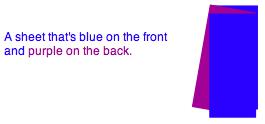
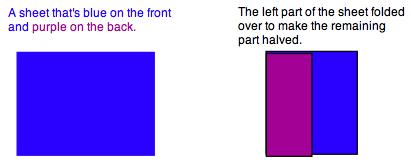
Having halved then let’s proceed to thirds and then quarters. It seems that most would go from halves to quarters probably haling and halving again. But for those who have mastered halving well , then, moving to thirds is a good challenge. There seems to be a variety of ways in which as adults we would third a sheet of A$4$. Some will often start loosely folding into a “Z” shape and shuffling it
around until the three parts are equal.
Others may fold from one side until the edge “halves” the remaining part.
So, we invite the pupils to share their new A$4$ sheets between three and asking them to explain how their ”thirds” are the same size. This has the potential of being a catalyst for a lot of thinking and discussion which can give the teacher an insight into how the pupils are thinking about fractions and/or area.
Before we leave sharing A$4$ sheets I have found it very valuable for pupils to be challenged with more unusual sharing situations. For example giving a group of five pupils $9$ sheets of A$4$ to share between them. Quite often I have found that “halving “ is the dominant feature here. It goes something like this:-
The $9$ sheets are shared $1$ at a time to each pupil and so there are $4$ A$4$’s left.
The $4$ sheets are then halved giving $8$ halves. These are shared leaving $3$ halves.
The $3$ halves are then halved giving $6$ quarters. These are shared leaving $1$ quarter.
The $1$ quarter is halved giving $2$ eighths – and they notice that’s not enough!
The $2$ eighths are halved giving $4$ sixteenths – again, not enough.
The $4$ sixteenths are then halved giving $8$ thirty-seconds ( that always seem to sound strange.)
There are enough of these to share $1$ each leaving $3$ thirty-seconds left,
The $3$ thirty-seconds are halved giving $6$ sixty-fourths.
These are shared and so there is $1$ sixty-fourth left.
Now comes the surprise. they take a pair of scissors cut that sixty-fourth (which is about the size of a postage stamp) and, as if it’s quite natural, they cut that $64$th into $5$ pieces,
(The fraction names used in this are just mine to be able to describe what happened, I’ve never come across the pupils using such words at this point – it’s all just a matter of halving.)
It’s just so surprising that they then cut the postage sized paper into parts to match the number of pupils sharing as if it’s just the normal thing to do. Some pupils may be able to name some of the small fractions that they came across when describing what each pupils has now got. i.e. 1 whole, 1 half, 1 quarter, 1 thirty-second and 1 sixty-fourth. The final part is one fifth of one
sixty-fourth.
I have found that after they have done two or three more of these kinds of problems they have a discussion and then decide that they could simply (in the above case) cut each of the eight A$4$’s into $5$ pieces giving each pupil $8$ one fifths each. They can then get to see more easily that 8 shared among $5$ is eight fifths. Some will probably go on to see that as one whole and three
fifths each. I remember well the excitement one child had over this discovery and came up to me and said “I can do any of these sharings in my head, ask me one.” Of course when I sain things like $13$ shared among $7$ she would quickly reply, “Thirteen sevenths!” Other children went on to repeat that kind of answer and then say that’s “One and six sevenths!”
Some re-inforcement of these beginning concepts in fractions can be carried out by using long narrow strips of paper. (I have got hold of ‘till rolls’ for this purpose.) According to the practical space you have available you give the pupils each a measured length of paper like $4$ metres. I used to have very many of the same lengths available so that the pupils can carry out many experiments. I
also made sure that there were many measuring devices freely available. (Tape measures, rulers, metre sticks etc.) I used to give them a few challenges and them allow them to suggest new challenges for themselves. So I would ask questions like, “What length of paper each, if you $4$ metre length has to be shared among $7$?
So far the sharing into parts has been with continuous material and we now come to discreet material – counters, cubes etc. I believe it is very useful to start with some simple sharing situations with counters/cubes. Giving every pupil something like $24$ of them and asking them to share them equally among various numbers of people. It is important also to allow a lot of discussion so that
pupils can raise questions about what they find out and for them to be able to ask questions as well. Pupils should be encouraged to think about the sharing that produces some counters/cubes left over. At some stage there will probably be a need to explore what to do with these “left-overs”. I remember, on one occasion, quickly getting some biscuits to use in place of counters/cubes. The
pupil I was working with, was working on 25 shared among three people. The left over biscuit was quite easily seen as something you could share among three.
A Bowl of Fruit is a suitable activity to engage the pupils in at this stage.
When situations like this happen it is not possible to prescribe the journey to the naming of fraction parts. Pupils, I have found tend to know the common names of halves and quarters but as to others its something with tends to occur when dealing with the A$4$ sheets mentioned earlier.
So many situations in around the classroom and the outside world require sharing to take place and pupils journeys of discovery will vary but it is good if we can journey with them.
Finally have a good look at this you tube video which shows two children practically working on a difficult sharing situation of $8$ sausages among $5$ people with a teacher who questions appropriately to get the thinking going.