Magic Constants
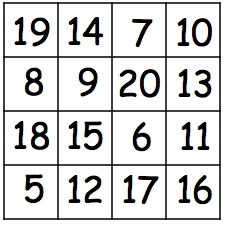
After the initial search for four numbers that add to the Magic
Constant in the initial given Magic Square investigation changes
direction.
The suggestion to find the Magic Constant if 2 is added to each
number, and if the numbers are doubled, should give hints enough
for pupils to explore ways of making different Magic
Constants.
Pupils should write down the function used to make each one then,
if different ways are found, the most simple one could be chosen.
Thus the idea of an 'elegant' method could be discussed.
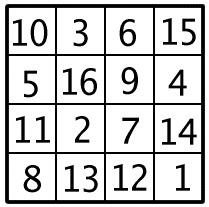
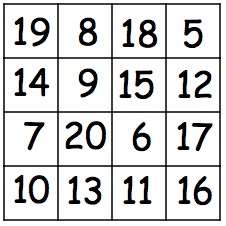
The given 4 x 4 Magic Square can be further explored. If, for
example, the left hand column is moved entirely to right hand side,
the square is still 'Magic'.
Similar changes as this can be explored and lists of more ways to
make the Magic Constant made. Do these cover all the ways of making
it from four numbers from 1 to 16?
What would the Magic Constant be for a 1 - 25 (5 x 5) Magic
Square?
Or a 1 - 36 (6 x 6) one?
-------------------------------
OLD SOLUTION
Tom did a superb job working on this Bernard's Bag problem.
He really did explore a great number of possibilities, and Tom is
wondering if there are even more investigations that he can
make.
Well done, Tom.
Here is a copy of the results that Tom came up with.
- The magic constant is 34. There are 8 2x2 squares - each corner
and each middle part of each side makes a square.
- If you add 2 to each number in the square then the magic
constant becomes: +95-14+17x0-20+62 = 42
If you double each number then the magic constant doubles to equal
68.
Or, you can make a square in which the magic constant is 17 by
halving each
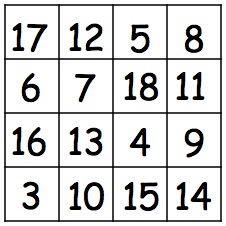
To make a square in which the magic constant is 38 you add one to
each number:
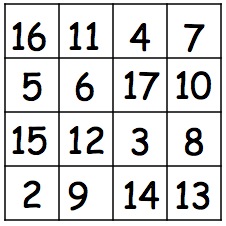
You can also make a magic square that has a magic constant of
50:
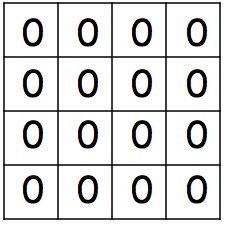
And, you can even make a magic square a magic constant of
zero!
Along the diagonals the squares can have the same totals along the
diagonals and still work - here is an example with the constant of
50
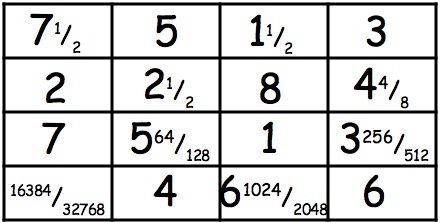
However, You can't make a square with a magic constant of 32 -
although you could if you allowed fractions to be used!