$2, 4, 6, 8, 10, 12 . . .$ $512, 256, 128, 64, 32 . . .$
$220, 210, 200, 190, 180, 170 . . .$ $11, 14, 17, 20, 23, 26 . . .$
Work out the rules that produced each of the patterns.
Well, let's form some patterns of our own. But this time we will use two maths operations [ 'operations' mean adding, multiplying, dividing, subtracting etc.] to produce each new number in the pattern.
You will use multiplication with either adding or subtraction. BUT you can have the multiplication last if you like.
So let's get started, you will need to do $5$ things for this work:
$1$) Choose a STARTING NUMBER (In my example suppose it's $7$)
$2$) Decide which OPERATION to do first [addition, subtraction or multiplication]
$3$) Decide what NUMBER to use with the operation you chose in ($2$)
$4$) Decide on your next OPERATION
$5$) Decide what NUMBER to use with the operation you chose in d.
My Choices are $7 x 4 - 5 $
Starting number $7 [ x 4 - 5 ]$ gives $23$
Now we use that $23$.....$ [ x 4 - 5 ]$ gives $87$
Now we use that $87$.....$ [ x 4 - 5 ]$ gives $343$
Remember we do have to do both operations and then write the result down.
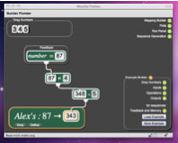
See this happening with Alex in this "Number Plumber" . You'll need to drag the $7$ where it says "number equals". Then click "drop" under the name "Alex"
I now write down ALL THE THINGS THAT I NOTICE ABOUT THIS PATTERN.
The answers go odd, even, odd, even . . . . .
The units figures go $7, 8, 1, 0, 7, 8, 1, 0 ,$ . . . etc.
You might be able to see lots more, I've just written down a few quick ones.
Take a look at a, b, c, d, e, that I used and make a SMALL CHANGE
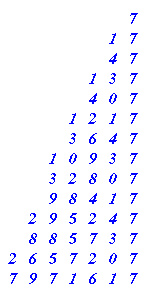
Starting Number $7 [ x 3 - 4 ]$ gives ......
Like before I write down all the things that I notice :-
The tens figures go $4, 3, 0, 1, 4, 3, 0, 1,$ . . .
Then I COMPARE what I noticed this time with last time, similar things and rather different things.
SO I might write something like:-
WELL after that L O N G introduction it's time for you to have a go!
 TO BE REPLACED BY MOVIE? OR http://nrich.maths.org/DataFlow/DataFlow.html?config=/content/id/6928/np6928.xml OR PPT?