Opposite Vertices
Why do this problem?
Many students think they are very familiar with squares and
rhombuses...
This problem requires a real appreciation of the properties of
these quadrilaterals in order to make and justify some interesting
generalisations.
Here is an
article that describes some of the background thinking that
informed the creation of this problem.
Possible approach
This problem requires students to draw tilted squares
reliably.
This
interactivity might be helpful to demonstrate to students what
a tilted square looks like. Students could play
Square It until
they can reliably spot tilted squares on a dotty grid.
A possible start which
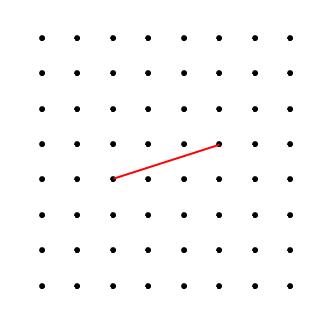
involves the minimum of teacher input is to display the line below
and say:
"Imagine we are drawing squares and rhombuses with vertices on
the dots of a square grid. This line can be
- the side of at least one square,
- the diagonal of at least one square,
- the side of at least one rhombus,
- the diagonal of at least one rhombus.
Work out how many different squares and rhombuses can include
this line, as either a side or a diagonal."
This leads on to the challenge "In a while, I am going to ask
you to work out how many squares and rhombuses could be drawn using
a different line. The challenge will be to answer without doing any
drawing."
Alternatively, start by showing the image of
Charlie's rubbed out squares, and give students some time to
recreate the squares on
dotty paper. Once they have finished, ask them to compare in
pairs - have they always drawn the same square? Are there any other
possibilities?
Bring the class together and share the techniques students were
using to complete the squares.
"Draw any line you like on your dotty paper, and then try to
complete a square using your line as one of the sides."
...
"Has anyone found a line that they can't use as a side of a
square?" (If someone has found one, display it on the board and ask
the class to help.)
"Do you think we can always
draw a square using any
line?"
Give students some time to discuss this and come up with
justifications for their answer.
Next show the image of
Alison's diagonals and give students time to recreate the
squares.
Again, ask them to share approaches.
"Draw any line you like on your dotty paper, and then try to
complete a square using your line as the diagonal."
This time, it can't always be done. If students are struggling to
work out when it can and can't be done, suggest that they draw some
squares and see what the diagonals have in common.
Then move on to
rhombuses.
"Draw any line you like on your dotty paper, and then try to
complete a rhombus using your line as one of the sides. How many
different rhombuses can you draw using your line?"
Give students time to do this for a number of different lines of
their own choosing, and then bring the class together to share
their findings.
"When we worked on squares, there were some lines that we couldn't
use as a diagonal. Will the same be true for rhombuses?"
Once again, give students time to explore.
Finally, bring the class together to share their ideas and justify
their findings.
One technique for testing ideas at the end is to set a specific
challenge, for example, to draw some lines and ask them to
determine how many rhombuses could be drawn using each line as a
diagonal.
Key questions
Is there a method for completing a square given one of the
sides?
Is there a method for completing a square given its
diagonal?
Is there a quick way to determine whether a given line could
be the side or diagonal of a square with points on the dots of a
square grid?
Is there a method for completing a rhombus given one of the
sides?
Is there a method for completing a rhombus given its
diagonal?
Is there a quick way to determine whether a given line could
be the side or diagonal of a rhombus with points on the dots of a
square grid?
Possible extension
Vector Journeys
challenges students to explore similar relationships using vector
algebra.
Possible support