
If a shotputter releases the shot at speed $v$, at angle $\theta$ to the ground and at a height $h$ above the ground, the trajectory of the shot is a parabola with coordinates determined by $(v\cos(\theta)t, v\sin(\theta)t - \frac{g}{2}t^2)$. Suppose the shot hits the ground at time T. Equating the $y$-component to $0$ gives $T^2 - \frac{2v\sin(\theta)}{g}T - \frac{2h}{g} = 0$. Solving gives $T=\frac{v\sin(\theta)}{g} + \sqrt{\frac{2h}{g} + \frac{v^2\sin^2(\theta)}{g^2}}$, so the range is therefore $d = \frac{v^2\sin(2\theta)}{2g}\left(1 + \sqrt{1 + \frac{2gh}{v^2\sin^2(\theta)}}\right)$
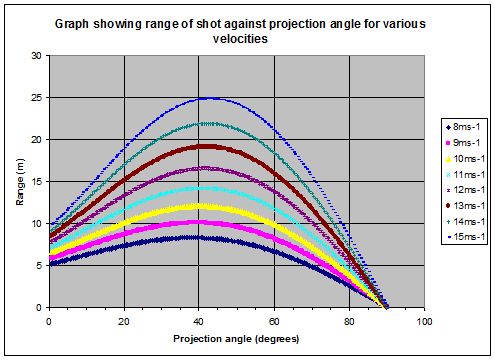
Assuming for the time being that the athlete can launch the shot at the same speed at any angle, I plotted a graph of range against projection angle for a variety of speeds:
Looking at the graph, it appears the optimal angle for maximising range is slightly smaller than $45^{\circ}$.
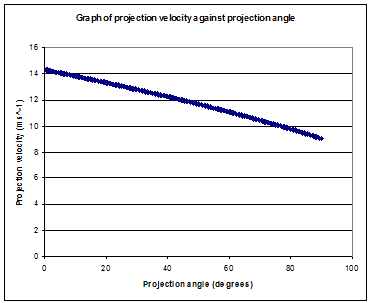
We now need to incorporate how the maximum launch speed varies with the projection angle. Here's a graph of projection velocity against projection angle. Although the projection velocity decreases as the projection angle increases, the range previously had a maximum at $45^{\circ}$, so the optimal angle will now be a tradeoff between angle and velocity.
We can now calculate the range of the shot using this projection velocity, and plot a graph of range against projection angle (using the same value of the parameters as before):
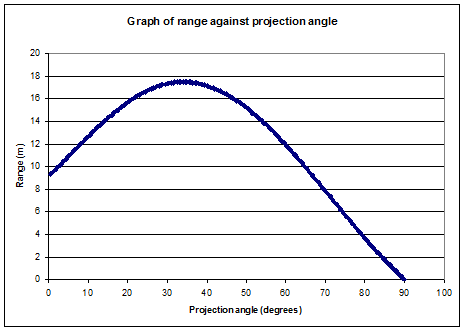
For these values of the parameters,we can see the optimal angle is now around $35^{\circ}$, as opposed to $45^{\circ}$ in the previous model.
You may be wondering why we haven't differentiated the range $d$ with respect to $\theta$ in order to find a stationary point. This results in a horrible expression, and doesn't seem to be solvable analytically, though it may be possible to use some complicated tricks to get an answer. (Try it if you don't believe me!)
Extension: Try adjusting the parameters and analyse how the maximum distance varies.