Great Squares
If we look at the time that the first square ABCD has been enlarged
to EFGH we get this picture:-
Square Pattern sqrpatTe3
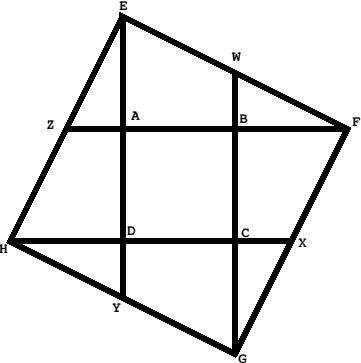
We have some geometric facts which can be derived. I'm putting
these into the notes because if you are working with particularly
able pupils you may need to get a glimpse of these relationships.
1. Pythagoras gives us the relationship at AF squared added to AE
squared will give us EF squared.
2. AB has been extended by the same length again so that AF is
twice as long as AB.
3. AE is the extension of AD and so the two are the same length.
It's nice to take the lengths of the sides of the inner square as
1.
So we see that AF is 2, AE is 1 and using that realization of
Pythagoras be have:
1^2 + 2^2 = EF^2
1 + 4 = 5
So the length of EF is the square root of 5 which is 2.236 ish.
But we can just call it "root 5" all the while.
You may find that some of these pupils look at areas.
The area of ABCD is 1 sq unit
The area of EFGH is root 5 multiplied by root 5 so is 5!
The areas of subsequently larger squares increases by powers of 5
as the lengths of the sides increase by powers of root 5.
When we come to the following diagram:-
Square pattern sqrpatTe4
Interesting discussions are to be had with pupils who have some
idea that Triangle BFW will swing around point W to fit on top of
EABW so as to form a square EAB(NewF).
Some pupils can treat this very usefully as a jigsaw and cut it out
carefully. Others may well use their intuition and others their
knowledge to get there.
When they have got there you can see the fact that the larger
square is equivalent in area to 5 of the smaller squares.
So we have done a construction that is fairly simple. Now look at
it the other way round and we have a large square in which 4 lines
have been drawn from the centre of each side to the appropriate
opposite corner. Now we also know that the area of the smaller
square is 1/5 of the larger. So, we can now be presented with a
square and be able to generate the square that has an area 1/5 of
the original!
Finally, I have not actually done the last bit with pupils but I
see that there can be great fun and discovery with acetate sheets
of the root 5 sided square placed over a whole array of smaller
squares of size 1.
This really has great potential for KS 2 3 4 and my undergraduate
students here at Cambridge!