The number $7$ must be at one end and must be next to $1$ since $7$ has no other factors or multiples under $10$. Without loss of generality we can assume $7$ is the first number, followed by $1$.
The number $5$ only has two possible adjacent numbers, $1$ and $10$. The same is true for $9$ which can only be next to $1$ or $3$. Hence either we must start with $7$, $1$, $5$, $10$ and end with $9$; or we start with $7$, $1$, $9$, $3$ and end in $5$. Either way this means that $1$ cannot be next to any other numbers.
The diagram below shows the only possible connections that can be used.
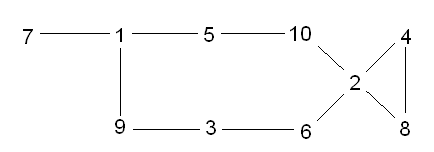
It is clearly impossible to link all ten numbers together without using $2$ twice. To see this imagine the sequence starts $7$, $1$, $5$, $10$, then the only possibility after $10$ is $2$ but the only possibility before $6$ is $2$ which means $2$ has to appear twice. Similarly if the sequence start $7$, $1$, $9$, $3$ we must also use $2$ twice.
However, the diagram suggests a possible list of nine numbers: $6$, $3$, $9$, $1$, $5$, $10$, $2$, $4$, $8$.
There are many other sequences of nine numbers that follow the rule. Can you find them all?