What Shape?
What Shape?
This is one of a series of problems designed to develop learners' team working skills. Other tasks in the series can be found by going to this article.
What are you aiming to do?
For the task:
One member of the team is trying to find out what is on their chosen card (the unknown) by asking as few questions as possible.
The rest of the team need to confer and agree on a "Yes" or "No" answer to each question and keep track of the number of questions that have been asked altogether.
As a team:
- asking questions - making sense of your own understanding
- being concise
- listening
- reflecting on what has been said.
Getting started
The task is designed to work with a team of four or five people. If you do the task several times, members of the team can take turns at trying to find the unknown. You may also wish to appoint an observer.
You will need the set of
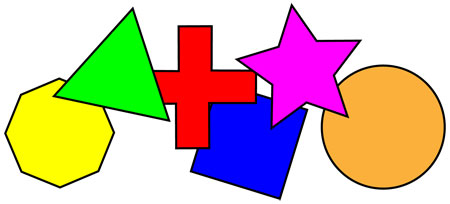
shape cards. Spread them out on the table so that everyone can see the sorts of shapes chosen for this task.
You will each need a sheet of paper and pencil.
Tackling the problem
Rules
- Choose someone on the team to keep track of the number of questions - this might be the observer.
- The person who has been chosen to try to find the unknown shape chooses a card and hands it to the rest of the team without looking at it.
- The person trying to find the shape can ask up to 8 questions.
- When a question has been asked, each of the other members of the team writes "Yes" or "No" on their sheet of paper. If they all agree one person gives the answer.
- If the team do not agree, they will need to confer - preferably out of earshot of the person trying to find the shape. Once in agreement, one person gives the answer.
- The person trying to find the unknown can have up to three attempts at guessing what is on the card before the task ends. Each guess counts as one of the 12 questions.
- The team can offer the hint "Cold" or "Warm" or "Hot" if the first or second guess is incorrect.
At the end of the task the team should discuss what proved to be good questions and less good questions. If the person does not identify what is on the card, discuss what questions might have worked more effectively.
Did you work well as a team?
Observer guidelines
- Keep track of the number of questions
- Make a note of questions you thought were effective and why
- Note when the team worked well together.
Why do this problem?
This task combines developing geometric understanding with speaking and and listening skills. It supports the development of basic geometric language encouraging children to talk about shapes using the correct mathematical language and accurate descriptions.
This task also aims to encourage learners to develop their ability to communicate their reasoning and to frame and ask questions. This task requires learners to make sense of their own understanding, be concise and listen and reflect on what has been said. (This is one of a series of problems designed to develop learners' team working
skills. Other tasks in the series can be found by going to this
article.)
Possible approach
The task is designed to work with teams of four with one chosen, in turns, to find the unknown.
Using a fifth person as an observer means that feedback can be very specific and works well either using another learner or an adult.
Here are the shape cards.
Allow the teams plenty of time to do the task, allowing every member of the team to take the role of trying to find the unknown.
The observer's role should include checking discussion takes place before an answer is given and keeping track of the number of questions.
When teams have finished working on the task it is important that they spend time discussing in groups, and then as a whole class, how well they worked as a team. They can consider what they have learned from the experience and what they would do differently next time, particularly in terms of how to listen to each other and ensure that all members of the team participate. Your own observations,
as well as those of observers might inform the discussions.
Finish the session by listing the key words associated with shape and space that arose whilst learners did the task.
Key questions
- Was there a question that proved really useful in identifying the shape?
- What kinds of questions helped you to identify the shapes most quickly?
- How well did you listen to each other in your team?
- How did you ensure that everyone had a chance to contribute?
Possible extension
You may wish to keep the shape cards hidden from the person trying to find the rule. Learners may like to try one of the other 'What am I?' tasks, which can be found by going to
this article.
Possible support
You may wish to give a copy of the shape cards to the person trying to find the unknown shape so that they have a sense of what they are aiming for. It is also possible to reduce the number of cards, perhaps focussing on polygons. Other team-building tasks can be found by going to this
article.