I Like ...
I Like ...
Mr Gilderdale was using this interactivity with his class:
This text is usually replaced by the Flash movie.
He had thought of a number rule and he asked the class to choose numbers to test.
If the number they chose fitted his rule, he put it under 'I like these numbers'. If the number they chose didn't fit his rule, he put it under 'I don't like these numbers'.
Here is a picture of the game after the class had chosen four numbers:
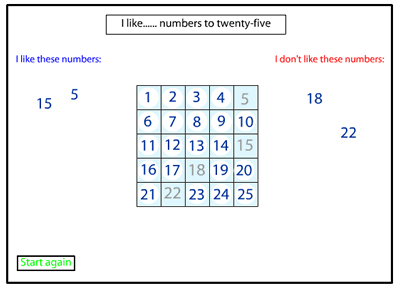
What could Mr Gilderdale's rule be?
If you were in Mr Gilderdale's class, which number would you choose next to test your idea?
How could you find out Mr Gilderdale's rule in the smallest number of guesses?
Why do this problem?
This problem challenges children to make sense of information by applying their knowledge of number properties. They are required to make and test hypotheses, and this will encourage them to work in a systematic way.
Possible approach
You could introduce this problem by demonstrating
the interactivity yourself. Choose a rule and invite children to offer numbers. If the number fits your rule, drag it to the 'I like ...' side of the screen. If the number doesn't fit your rule, drag it to the other side. Try to remain silent during the activity so the only feedback the children get
is the position of their chosen numbers. You might insist that the children must all agree on the rule before someone is allowed to check it with you. You could challenge them to find the rule by choosing, for example, fewer than ten numbers.
Once they are familiar with the way the game works, show them the picture of Mr Gilderdale's class's game and set them off on the problem itself, perhaps working in pairs. You may need to bring them together for a 'mini plenary' at some stage, so they can share how they are getting on so far.
In a plenary, you could use the interactivity to work through their suggested solutions, encouraging them to justify their ideas.
Of course this game can be played without the interactivity at all, which means that the choice of numbers is completely unrestricted. You could start off a game on the board, which could continue over several days. In this way, learners can form a hypothesis for your rule, but you will not confirm their hypothesis, you will only place numbers in the appropriate column.
Key questions
What do the numbers Mr Gilderdale likes have in common? What is the same about them?
What do the numbers Mr Gilderdale doesn't like have in common?
What number could you choose to test your idea?
Possible extension
Some children might like creating their own 'snapshots' of an imaginary game, so that the rule is ambigous.
Possible support
Having a
hundred square to mark the 'I like' numbers on might help some children see, and understand, a pattern.