Become Maths Detectives
Become Maths Detectives
Have a go at becoming a detective.
Watch the video below:
This text is usually replaced by the Flash movie.
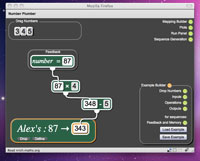
You can now explore this further. Click on the picture to get started.
When you've explored what you can do with $3 \times 4 - 5$ then it's time to explore further.
You could change just one part of the number plumber, for example the $-5$ bit.
You might try $3 \times 4 - 6$ or $3 \times 4 + 5$ or $3 \times 3 - 5$ and compare the results.
You'll have lots of your own ideas about things to explore too.
Mathematicians like to ask themselves questions about what they notice.
What possible questions could you ask?
These questions may lead you to make conjectures -(something which you believe to be true but need to investigate further in order to convince yourself .)
Why work on this project?
This month's NRICH site has been inspired by the way teachers at Kingsfield School in Bristol work with their students. Following an introduction to a potentially rich starting point, a considerable proportion of the lesson time at Kingsfield is dedicated to working on questions and ideas generated by children.
Working on
this project can encourage learners to work together, discuss ideas, test things out and explore further. This is how it is to be a mathematician, working alongside other mathematicians, which children can experience within our own classrooms.
Possible approach
After the pupils have seen and written down the numbers as they appear at the bottom of the screen it is time for them to be Maths Detectives.
Ask them what they notice about the numbers. Encourage them to articulate anything at all - any pattern. You could ask them to talk about what is the same and what is different about the numbers in the list, which might get them started.
It could be that someone notices the number of digits in each of the numbers and how they increase. It may be that they notice a pattern in the units numbers, or the tens or ...
This sheet shows some possible patterns learners might explore. (It is intended to show you the possibilities rather than being a sheet to
share with children.) It can sometimes be interesting to explore the digital roots too, see
this article. By working in this exploratory way the pupils can be looking at number patterns that NO-ONE has ever explored before. WOW!
For teachers who want to create their own alternatives to
Become a Maths Detective for use in the classroom, Mike's blog
Grumplet describes some instructions and rationale.
Key questions
So, you've noticed ... what could we do with that?
So, you've got the idea that ... could we explore this further?
What slight change could you make to the set-up so that we explore something similar?
What possible questions could we ask?
Can you make any predictions about what might happen when we change the set-up?
What is the same? What is different?
Can you explain?
Possible extension
When the pupils explore further by changing just one part of the $5$ parts that make up the first number pattern. i.e. $3\times4-6$ or $3\times4+5$ or $3\times3-5$ etc new results wll be found and can be compared. The operations being explored can be changed in many different ways.
Possible support
Some pupils may find a calculator useful or they may want to use practical resources to support their calculation skills.