Table Patterns Go Wild!
Rajeev
from Fair Field Junior looked at the first row of grids in the
problem and said:
In any grid where every
$4$th square is shaded then it will contain multiples of $4$ and so
on. In the $7$ grid as every $3$rd square is shaded it has
multiples of $3$, in the $5$ grid where every $2$nd square is
shaded you get multiples of $2$ and in the $8$ grid where every
$5$th square is shaded you get multiples of $5$ and if you get a
negative diagonal line in the $6$ grid starting from the $1$st
square in the $2$nd row you get multiples of $7$.
For the
row of grids where you could only see the top of them, Rajeev
said:
If it's a $7$ grid and
every $4$th square is shaded it contains multiples of $4$. I have
also noticed that the lines run parallel diagonally and the
difference between the shaded squares is $3$ in the $7$ grid so
every diagonal line will contain multiples of $4$.
If the lines run
diagonally parallel and the difference between shaded squares in a
row is $2$ then all the diagonal lines will have multiples of
$3$.
Where every $2$nd square
is shaded then it contains multiples of $2$ and as explained the
last column in any grid will contain multiples of that grid.
Rajeev
goes on to say that where the edges are not shown you can still
identify the tables:
In the $1$st grid the
line is negative running diagonally and if more than $4$ squares
are shaded it must be a $6$ grid or more and the tables could be
$7$ or more.
What can
we say about the relationship between the grid size and times table
in this first grid, I wonder?
In the $2$nd grid as the
line is positive and running diagonally and at least $4$ squares
are shaded the grid must be at least $5$ by $5$ or more.
With the $3$rd pattern it
is a $9$ grid and contains $6$ times table, because the difference
between the squares horizontally is $5$ and vertically $1$. The
grid must be a multiple of $3$.
With the $4$th pattern it
is an $8$ grid and has multiples of $3$. The grid could also be
$11$, $14$, $17$, $20$, $23$ ... .
The last grid must be $8$
or more.
I
wonder what else we can say about the last grid? Fantastic work,
Rajeev. You've explained your thinking very clearly.
Grace,
Libby, Chloe-Anne and Becky from Maldon Primary School looked at
the patterns of tables on differently-sized grids. Chloe-Anne
pointed out:
$2$x on an even grid will go down in columns and on an odd grid it
is like a checkerboard.
Becky
noticed:
If you have a number and it's that type of number grid eg $7$ by
$7$ grid means that you would get the $7$ times table going
downwards or eg $5$ by $5$ grid you would get the $5$ times table
going downwards in a straight line.
So, I
think Becky is saying that when you create the pattern of the times
table that is the same as the size of the grid, you get a straight
line going downwards, or vertically. Well spotted!
Mrs
Cresswell's Maths Group from Manor School, Didcot wrote:
We really enjoyed trying the times tables on $10$x$10$ grids and we
found a pattern we could describe for all the times tables except
the $7$ times table!
We noticed that the $9$x table had a diagonal pattern because the
grid was one larger than $9$, so the number we coloured in ended up
one further back on the row below each time.
We tried this out with other numbers that were one less than the
size of the grid, and found that this always makes a diagonal
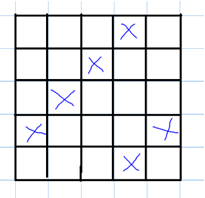
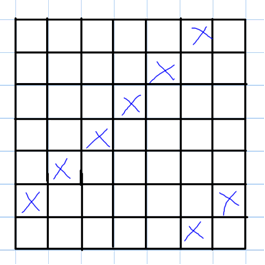
pattern. We drew a picture of the $4$x table on a $5$x$5$ grid and
the $6$x table on a $7$x$7$ grid to show you:
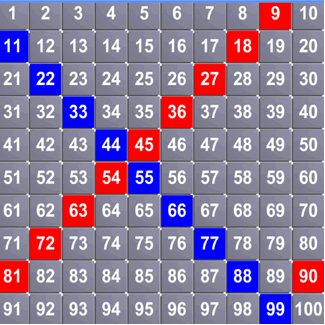
We wanted to make a diagonal going the other way, so we tried times
tables that were one bigger than the grid. We did the $11$x table
on a $10$x$10$ grid, and got a diagonal going down from left to
right, because the tens and the units got bigger each time.
Thank you
to everyone who submitted solutions to this problem. There's so
much to explore here, isn't there?