Cyclic Quadrilaterals
This problem is in two parts. The
first part consists of four similar challenges which provide
building blocks to help you to solve the final challenge. You could
work on them with others, but if you are working on your own, you
may not need to attempt all four.
Of course, you are welcome to go
straight to the Final Challenge!
In this problem, you will be working with cyclic quadrilaterals. A
cyclic quadrilateral is a quadrilateral whose
vertices lie on a circle. There is an interactivity at the bottom
of the page which you can use to create cyclic
quadrilaterals.
Click on one of the questions below to get started.
Question A
Using a circle with
nine evenly spaced points around the edge,
draw triangles which use the centre of the circle as one of the
vertices. You may find these
nine-point circles
useful.
How many different triangles can you find?
Work out all the angles in these triangles.
On a nine-point circle, we can join four points to create cyclic
quadrilaterals. Here are two examples:
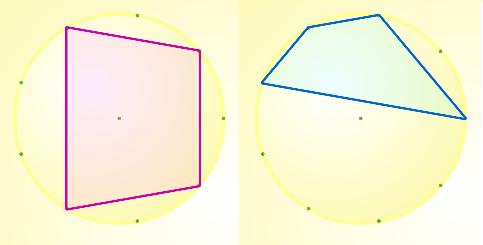
Create at least six different cyclic quadrilaterals on nine-point circles.
Split your quadrilaterals into triangles, and use your earlier results to
work out the angles in your quadrilaterals.
What do you notice about the
angles on opposite vertices of your quadrilaterals?
Question B
Using a circle with
twelve evenly spaced points
around the edge, draw triangles which use the centre of the circle
as one of the vertices. You may find these
twelve-point circles
useful.
How many different triangles can you find?
Work out all the angles in these triangles.
On a twelve-point circle, we can join four points to create cyclic
quadrilaterals. Here are two examples:
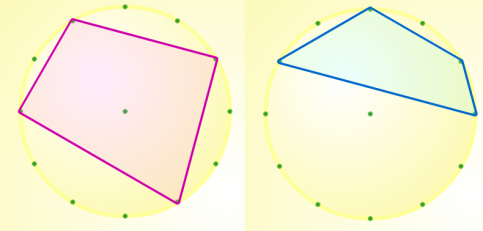
Create at least six different cyclic quadrilaterals on twelve-point circles.
Split your quadrilaterals into triangles, and use your earlier results to
work out the angles in your quadrilaterals.
What do you notice about the
angles on opposite vertices of your quadrilaterals?
Question C
Using a circle with
fifteen evenly spaced points
around the edge, draw triangles which use the centre of the circle
as one of the vertices. You may find these
fifteen-point circles
useful.
How many different triangles can you find?
Work out all the angles in these triangles.
On a fifteen-point circle, we can join four points to create cyclic
quadrilaterals. Here are two examples:
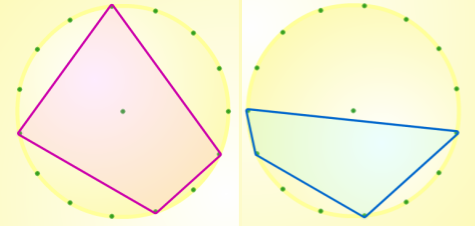
Create at least six different cyclic quadrilaterals on fifteen-point
circles. Split your quadrilaterals into triangles, and use your earlier
results to work out the angles in your quadrilaterals.
What do you notice about the
angles on opposite vertices of your quadrilaterals?
Question D
Using a circle with
eighteen evenly spaced points
around the edge, draw triangles which use the centre of the circle
as one of the vertices. You may find these
eighteen-point circles
useful.
How many different triangles can you find?
Work out all the angles in these triangles.
On an eighteen-point circle, we can join four points to create
cyclic quadrilaterals. Here are two examples:
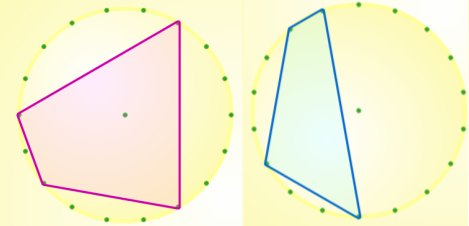
Create at least six different cyclic quadrilaterals on eighteen-point
circles. Split your quadrilaterals into triangles, and use your earlier
results to work out the angles in your quadrilaterals.
What do you notice about the
angles on opposite vertices of your quadrilaterals?
Final Challenge
What can you say about the
angles on opposite vertices of any cyclic quadrilateral?
Use a diagram like the one below to create a convincing
argument.
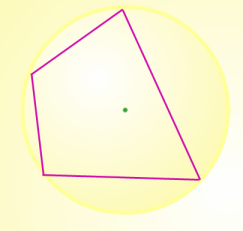
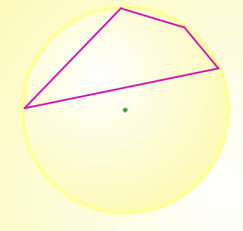
Does your argument still work if the centre of the circle is not
within the quadrilateral?
You may find this Virtual Geoboard useful.
Full Screen
Version
This text is usually replaced by the Flash movie.