$$f(r) = Nr^2e^{-\frac{2r}{a}}$$
I feel that the easiest way to think of this curve is to first consider the curves $r^2$ and $e^-r$ separately, then consider the shape of the curve produced when multiplying the two together.
$r^2$ grows with r whilst $e^{-r}$decays to 0 with increasing r
when r is very small $e^{-r}$ $\approx$ 1, therefore the curve is effectively $r^2$.
when r $\to \infty$ $e^{-r} \to 0$, when we multiply the two numbers together a very small number will therefore result.
At r = 0, f(r) = f(0) = 0
at f(r) = 0
either $r^2$= 0 therefore r = 0
or $e^{\frac{-2r}{a}} = 0 $ therefore r =$\ln(0) = \infty$
as r $\to \infty f(r) \to 0$
If we now differentiate the function we will be able to find its turning points
$ \frac{d}{dr} Nr^2e^{-\frac{2r}{a}}$= $2Nr(1 - \frac{r}{a})e^{\frac{-2r}{a}}$
When $ \frac{d}{dr}$ = 0 we find r =0, r= a and r = $\infty$
If we now differentiate once more to determine the nature of each of the turning points we find that:
$ \frac{d^2f}{dr^2}= \frac{d}{dr}2Nr(1 - \frac{r}{a})e^{\frac{-2r}{a}}$
=$2(1-\frac{r}{a} + )(2r)(\frac{-1}{a}))Ne^{\frac{-2r}{a}} + (\frac{-2}{a}(2r)(1 - \frac{r}{a})Ne^{\frac{-2r}{a}}$
at r = 0 $ \frac{d^2f}{dr^2}=2N$ which is greater than 0, therefore r = 0 is a minimum
at r = $\infty$ $ \frac{d^2f}{dr^2}= 0$
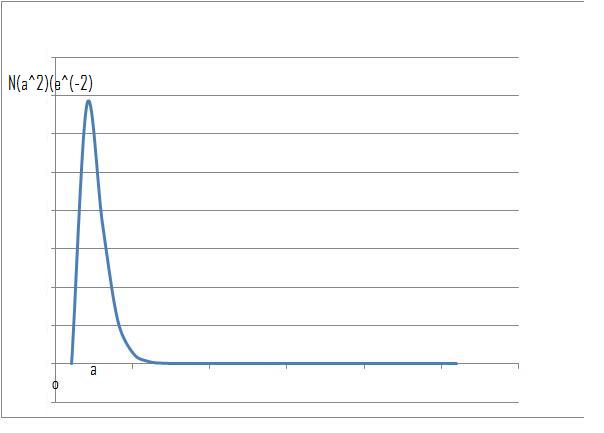
at r = a $ \frac{d^2f}{dr^2}=-2Ne^{-2}$ which is less than 0, therefore r = a is a maximum.
From the above information we can deduce the general shape of f(r) as shown below.
(Note: The graph below has been plotted assuming all constants equal 1 )
2. Potential energy for the vibrational modes of ammonium
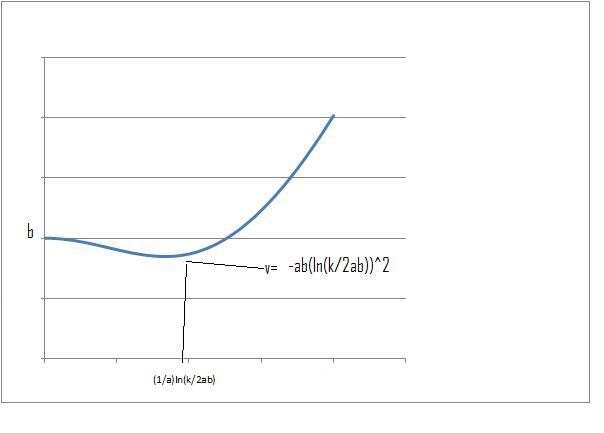
$$ V(x)=\frac{1}{2}kx^2+be^{-ax^2} $$
When x is very small $v(x) \approx be^{-ax^2}$
and when x is large $e^{-ac^2} \to 0$, v(x) $\approx \frac{1}{2}kx^2$
when x = 0, v(0) = b
by inspection it can be deduced that v(x) can never reach 0 as $be^{-ax^2}$ is always greater than 0 and $\frac{1}{2}kx^2$ is greater than 0 at all x except x=0, but at this point $be^{-ax^2}$= b
as x $\to \infty$ v(x) $\to \frac{1}{2}kx^2 \to \infty$
If we now differentiate the function we will be able to determine its turning points.
$ \frac{dv}{dx} = xk - 2abxe^{-ax^2} = x(k-2abe^{-ax^2})$
when $ \frac{dv}{dx}$ = 0 we find x = 0 and
$(k-2abe^{-ax^2}) =0$
therefore x = $ \sqrt(\frac{-1}{a}\ln(\frac{k}{2ab}) $
If we now differentiate once more to determine the nature of each of the turning points we find that:
$ \frac{d^2v}{dx^2}= k - 2abe^{-ax^2} + 4a^2bx^2e^{-ax^2}$
at x = 0, $ \frac{d^2v}{dx^2}= k- 2ab$ , the nature of this turning point will therefore depend on the relative magnitudes of the constants a,b and k. If k is greater than 2ab, x=0 will be a minimum but if 2ab is greater than k it will be a minimum.
at x=$ \sqrt(\frac{-1}{a}\ln(\frac{k}{2ab}) $ we should expect a minimum (or possibly a point of inflexion) as a consequence of the fact that as there are only two turning points and as x $\to \infty$ $v(x) \to \infty$(it therefore cannot be a maximum).