Striking Gold
This problem allows for a range of
sophistications in calculation. The first stages are all about
making rough approximations using the given approximation for the
radius of the atom
$r_A = 1.2 \times A^{\frac{1}{3}}$
$\Rightarrow r_A\ \alpha \ A^{\frac{1}{3}}$
$\mathbf{\Rightarrow A\ \alpha \ r_A ^3\ \alpha \ Volume}$
The original expression makes sense since each time the atomic mass
increases, the volume roughly increases by a set amount since ~ 1
proton and 1 neutron are added each time.
The radius of the alpha particle is calculated by recognising that
an alpha particle is simply a helium nucleus. Therefore, it has an
atomic number of 2, which can be substituted into the previously
given formula:
$A_\alpha = 2$
$\mathbf{r_2 = 1.2\ \times\ 2^{\frac{1}{3}} = 1.51\
\text{fm}}$
The radius of the gold nucleus can be calculated by identifying
that gold's atomic number is 79, and then substituting this into
the given equation::
$A_{Au} = 79$
$\mathbf{r_{79} = 1.2\ \times\ 79^{\frac{1}{3}} = 5.15\
\text{fm}}$
This scatting parts of the problem allows
for a range of sophistications in calculation. The first step is
simply to assume that the alpha particle is a point
mass:
Deflection only occurs if an alpha particle collides with the
nucleus of the gold atom. The simplest approach to this part of the
problem is to assume that the alpha particle is a point mass. This
modelling assumption means that the probability of it being
deflected by the gold atom is the ratio of gold atom's nuclear
cross-sectional area to the total atomic cross-sectional
area:
$p(deflection\ by\ gold\ atom) =\left({\frac {Cross-sectional\
Area_{nucleus}}{Cross-sectional\ Area_{atom}}}\right)
=\left({\frac{r_{nucleus}}{r_{atom}}}\right)^2
=\left({\frac {5.15\ \times\ 10^{-15}}{135\ \times\
10^{-12}}}\right)^2$
$= \mathbf{1.45\ \times\ 10^{-9}}$
Parin and Matt continued to look at more
detailed ways of considering the scattering of the alpha particles,
starting with considering the possibility of glancing
blows:
A slightly better approach to modelling the situation is not to
assume that the alpha particle is a point mass, but to instead
insist that it has physical dimensions. It can be reasoned that a
deflection will now occur not just if there is a direct impact with
the nucleus, but also due to a glancing blow if the alpha
particle's centre of mass passes at a distance of $r_{nucleus}$ and
$r_{nucleus} + r_{\alpha}$ of the centre of the gold nucleus. Thus,
it can be thought that the gold atom's nucleus has an effective
radius of $r_{nucleus} + r_{\alpha}$:
$p(deflection\ by\ gold\ atom) =\left({\frac {Effective\
Cross-sectional\ Area_{nucleus}}{Cross-sectional\
Area_{atom}}}\right) =\left({\frac{r_{nucleus}\ +\
{r_{\alpha}}}{r_{atom}}}\right)^2 $
$=\left({\frac {5.15\ \times\ 10^{-15} +1.51\ \times\
10^{-15}}{135\ \times\ 10^{-12}}}\right)^2 = \mathbf{2.43\ \times\
10^{-9}}$
Note that this 'glancing blow' calculation
assumes that particles behave like Newtonian billiard balls. In
reality, the boundaries of the nuclei are somewhat blurred and the
effects of quantum chemistry will need to be taken into account to
develop a, so-called, effective scattering cross
section.
The final part of this question can be tackled with varying degrees
of assumptions. The simplest approach to the scenario is to assume
that the alpha particle will pass through layers of gold atoms but
that the probability of being stopped by each layer is independent
of previous layers. Thus, by multiplying the probability of being
stopped a layer by the number of layers, the total probability of
deflection will be calculated. An additional assumption is that the
gold particles have 100% efficient packing in the lattice.
$n \times p(deflection\ by\ one\ layer) = p(deflection\ by\ gold\
sheet)$
$n \times (2.43\ \times\ 10^{-9}) = \frac{1}{8000}$
$\mathbf{n = 51346 = 51300\ layers\ (3\ s.f.)}$ using the more
rigorous value of $p(deflection\ by\ gold\ atom)$
A more rigorous approach to calculating the number of layers is as
follows: let $\beta$ denote $p(deflection\ by\ gold\ atom)$. The
probability that an alpha particle is deflected by the first layer
is simply $\beta$; the probability that it is deflected by the
second layer is conditional on it passing through the first layer,
and is given by $(1-\beta)\beta$; the probability that it passes
through the $n^{th}$ layer is $(1-\beta)^{n-1} \beta$. Therefore,
the overall probability of deflection is:
$ p(deflection\ by\ whole\ sheet) = \beta + (1-\beta)\beta +
(1-\beta)^2 \beta + (1-\beta)^3 \beta + ... + (1-\beta)^{n-1}
\beta$
This is a geometric series which gives:
$p(deflection\ by\ whole\ sheet) = 1- (1-\beta)^n$
$\therefore n = \frac{\log(1-p(deflection\ by\ whole\
sheet))}{\log(1-\beta)}$
Using the rigorous value for $\beta$ gives:
$\mathbf{n =51350 = 51400\ layers\ (3\ s.f.)}$
A further approach to calculating the number of layers is to
realise that the gold atoms do not pack with 100% efficiency into
the lattice, and that there is a degree of unfilled space. The
formula calculated previously using $\beta$ is still applicable,
but an adjusted value of $\beta$ must first be calculated.
The face of a unit cube of a gold lattice is shown below. By
modelling the lattice such that each gold atom is as large as
possible such that the gold atoms touch but overlap, the dimensions
of the unit cube can be calculated as a function of the atomic
radius.
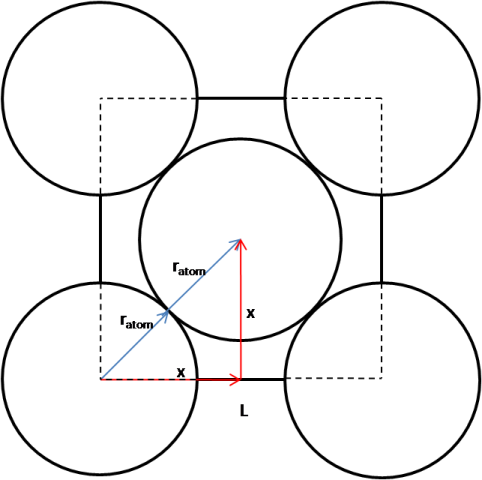
$x^2 + x^2 = (r_{atom} + r_{atom})^2$
$\rightarrow 2x^2 = 4r_{atom}^2$
$\therefore x = \sqrt{2} r_{atom}$
$\therefore L = 2x = 2\sqrt{2} r_{atom}$
$ Cross-sectional\ area = 8 r_{atom}^2$
It should be noted additionally that each unit cube contains a
total of 2 gold nuclei.
$\therefore \beta = \frac{2 \pi (r_{nucleus} + r_{\alpha})
^2}{8r_{atom}^2} = \frac{\pi}{4} (\frac{r_{nucleus} +
r_{\alpha}}{r_{atom}})^2$
$\beta = \frac{\pi}{4} (\frac{(5.15 +1.51)\times 10^{-15}}{135
\times 10^{-12}})^2$
$= 1.91\ \times\ 10^{-9}$
$\mathbf{\therefore n = 65380= 65400\ layers\ (3\ s.f.)}$
Now, having used three methods of varying rigour to calculate the
number of layers of gold atoms there are, the inter-layer spacing
must now be calculated in order to ascertain what the thickness of
the gold sheet is.
From the previous diagram of the unit cube, it can be seen that the
distance between each layer of gold atoms is given by $x$. Thus,
remembering that the gold lattice is flanked by a layer of gold
atoms at both ends, the thickness is given by:
$Thickness = (n-1) \times x$
Using the most sophisticated value of n gives:
$Thickness = (65380 - 1) \times \sqrt{2} r_{gold\ atom}= 65379
\times \sqrt{2} \times 135 \times 10^{-12} = \mathbf{12.5 \mu
m}$