Cuboid Challenge
Why do this problem?
This problem offers opportunities for visualising, and for
consolidating the formula for working out the volume of a cuboid,
while at the same time challenging students to conjecture, test out
ideas and compare different strategies for arriving at an optimum
solution.
Possible approach.
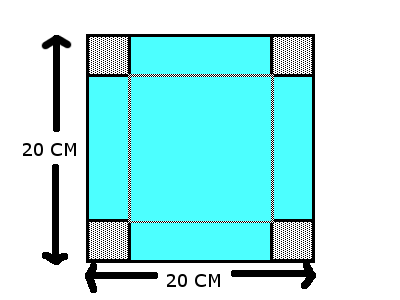
"Visualise a 20 by 20 square sheet of paper. Now imagine cutting
out a square of side 4cm from each corner, and folding up the
flaps. Turn to your neighbour and check you agree what the
dimensions of the resulting box will be. Try to do this without
writing anything down or using your hands to gesture."
Bring the class together and confirm the dimensions, and the
resulting volume.
Allow some time for the students to work in pairs to explore the
effect of different sized cuts on the volume of the resulting box.
Can they find the largest possible volume?
Collect the results and list them in an ordered table. Ask about
any noticeable patterns or trends. What is the maximum volume that
anyone has found? Can we improve on this?
There are different possibilities for this:
some students may use trial and improvement, possibly using
calculators;
some students may draw up a spreadsheet and use trial and
improvement;
some students may draw up a graph and look for maximum
values.
Encourage some students to try each method so that you can bring
the class together to compare and discuss their results.
Ask each pair of students to choose a different sized starting
square and find the cut which produces the maximum volume.
Collect these on the board and ask for any comments, and what
patterns they notice.
Key questions
How can you be sure you have found the maximum volume?
Can you convince someone else?
Possible extension
Instead of starting with square sheets of paper, students may
investigate rectangular ones. In order to make pattern spotting
easier, you may wish to organise this this in some way, for example
giving different groups of students sets of rectangles (such as
rectangles where the length is twice the breadth, three times the
breadth, four times the breadth etc.)
Possible support
Offer students 20 x 20 square grids
and encourage them to make different sized boxes, working
systematically and recording their results as they work.