Can They Be Equal?
Why do this problem?
Sometimes area and perimeter of rectangles are taught separately,
and are often confused. In this problem students consider the
relationship between them and are being challenged to engage in
some sophisticated mathematical thinking.
Possible approach
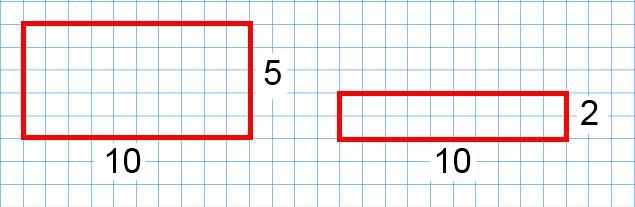
Show the students
this
image and ask them to work out the area and perimeter of each
rectangle.
Collect answers.
"That's interesting, the first rectangle has an area that is
numerically greater than the perimeter, but the second one has an
area that is numerically less than the perimeter. I wonder if you
could find a rectangle whose area and perimeter are numerically the
same?"
Set students to work on this challenge, perhaps encouraging
them to work in pairs so they can share ideas on how to
proceed.
"If you manage to find a rectangle that satisfies my
conditions, see if you can find a few more."
Circulate and observe the methods and reasoning students are
using. Look out for students who:
- fix one attribute (side length, area, perimeter) and vary
the others using trial and improvement
- fix one attribute and use algebra to solve for the other
attributes
- write an algebraic expression for area and perimeter, equate
them, and substitute values into the resulting equation
For students who are struggling to get started:
"What is the same about the two rectangles we started
with?"
"What could you change?"
"How does the area and perimeter change as you change the
height of the rectangle?"
Once everyone has had a chance to find a few rectangles that
satisfy the condition, collect together the dimensions on the
board.
Invite students to share any different strategies you observed
them using as they were working.
"I'd like you to have a go at finding a few more rectangles,
using several different strategies."
"While you are working, think about how many different
rectangles we could possibly find."
Finish off by asking students to share their ideas about how
many different rectangles satisfy the criteria, together with
convincing arguments about why there are infinitely many.
Possible extension
Ask students to consider other polygons with numerically equal
areas and perimeters - those who have met Pythagoras' theorem could
investigate right-angled and isosceles triangles, and those who
have met trigonometry could work on regular polygons.
Students could be invited to consider cuboids whose surface
area is numerically equal to their volume.
Possible support
A more scaffolded introduction to the problem:
Tell the students you are thinking of a rectangle. Ask them to
work out its dimensions if:
the area is 24 and the perimeter is 20
the area is 24 and the perimeter is 22
the area is 24 and the perimeter is 28
the area is 24 and the perimeter is 50
Record the solutions on the board. Ask the students to comment
on anything they notice. (This might be to do with the shape of the
rectangles, or perhaps the evenness of the perimeters.)
Repeat the process keeping the perimeter fixed this time, to
20.
Can they find the dimensions of rectangles with areas of 9,
16, 21, 24, 25?
Another activity to help students to become fluent in working
out the different attributes of rectangles:
Students could make up their own card matching game where each
set contains three cards about a specific rectangle, one with area,
one with perimeter and one with the dimensions. Students have to
find all three in a set. Each student produces 8 sets, shuffles
them and hands them on to their neighbour to sort.