Curved Square
The points of intersection are
$(\frac{\sqrt{3}}{{2}}, 0.5), (1-\frac{\sqrt{3}}{{2}}, 0.5)$ and the same with x, y interchanged
Estimate for the centre area is based on a square
From coordinate geometry, the squared side length of the square (and thus the area) linking the points of intersection is
$2-\sqrt{3}$
There were several interesting solutions to this problem, using a variety of different approaches, along with many lovely images. We are sorry that we couldn't include all of the solutions in full! The answers were:
The area of the shaded area is
$$
\frac{\pi}{3}+1-\sqrt{3}\approx 0.31517
$$
The area of the largest square which can be inscribed is
$$
2-\sqrt{3}\approx 0.267949
$$
The error is about $15\%$.
InNyeong from Nanjing International School placed the shape on a coordinate grid to express all of the lines in algebraic form and solved for the resulting intersections numerically, with a beautifully written up solution:
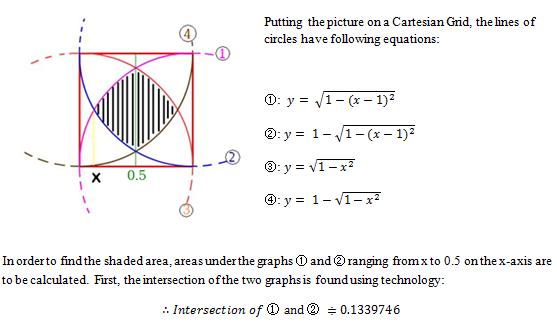
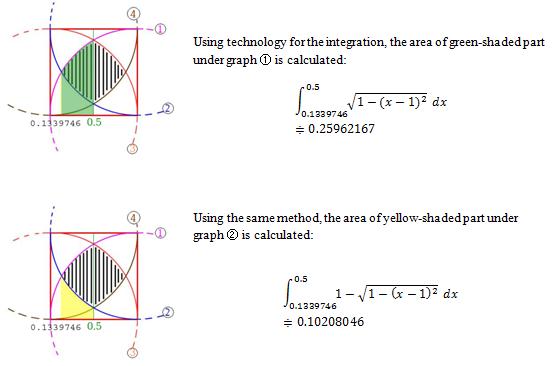
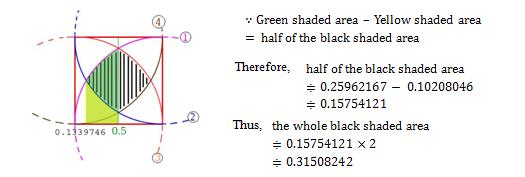
Ammar Ali followed a similar approach to InNyeon. although his solution was entirely algebraic. He found the equations of the curves and then solved algebraically, finding the coordinates for the points of intersection to be
$$
\left(\frac{\sqrt{3}}{2},\frac{1}{2}\right)\quad \left(\frac{1}{2}, \frac{\sqrt{3}}{2}\right)\quad \left(1-\frac{\sqrt{3}}{2}, \frac{1}{2}\right)\quad \left(\frac{1}{2}, 1-\frac{\sqrt{3}}{2}\right)
$$
The distance between two points $(x_1, y_1)$ and $(x_2, y_2)$ is given by
$$
d=\sqrt{\left(x_1-x_2)^2+(y_1-y_2)^2\right)}
$$
By using this formula we can find the squared distance $L^2$ between neighbouring points:
$$
L^2 = 2-\sqrt{3}
$$
This is the area of the largest possible square that fits in the centre.
Ammar then proceeded with calculating the integrals of the curves exactly, finding the correct expression for the areas. We liked this method a lot because it could be generalisable to curves other than circles (such as ellipses). To perform the calculation, Amman used the knowledge of the points of intersection, integrals and the additive properties of areas
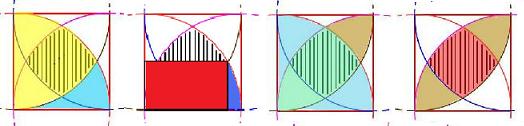
Yike provided an interesting solution based upon the following modified image:
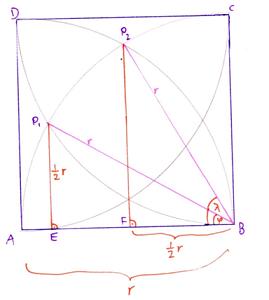
Trigonometry shows that $\lambda = 60^\circ$ and $\phi = 30^\circ$. The cosine rule on triangle $OP_1P_2$ gives $Q=(P_1P_2)^2=2-\sqrt{3}$, which is also the area of the largest inscribed square (since it is the side-length squared!)
To find the exact area $C$, note that the area of triangle $P_1P_2B = 0.5 r^2\sin(\lambda -\phi)=0.5 \sin(30^\circ)=0.25$.
So,
$$
C= Q+4\left(\frac{(\lambda-\phi)\pi r^2}{360^\circ}-0.25\right) = 2-\sqrt{3}+4\left(\frac{\pi}{12}-0.25\right) =1-\sqrt{3}+\frac{\pi}{3}
$$
Bugboy sent a classic geometric proof based on areas of sectors of circles, a very similar approach to that used by Roy from Nanjing International School:
The largest square has vertices at the 4 points where two arcs meet within the square. Because the arcs are 1 unit, the same as the side length of the square, the point where arcs meet and the opposite side of the square form an equilateral triangle. Therefore the distance between the point and the far edge via the perpendicular bisector (which also goes through the opposite corner of the inside
square) is$\frac{\sqrt{3}}{2}$. The distance between a corner and the opposite side, plus the distance between the opposite corner and the correspondingly opposite side is $2\frac{\sqrt{3}}{2}=\sqrt{3}$. Each $\frac{\sqrt{3}}{2}$ line is made of two parts: the distance between the two corners of the inside square, and then the distance to the side of the outer square. We have two of each in
$\sqrt{3}$. The entire distance from one side to another of the outer square is $1$, and this consists of 2 end sections and 1 section between the two corners. Therefore $\sqrt{3} -1$ is just the one diagonal length of the inner square. The diagonal of any square is the side length multiplied by $\sqrt{2}$, so in this case the side is $\frac{\sqrt{3} -1}{\sqrt{2}}$. Square that for the area of
the inner square: $\frac{4-2\sqrt{3}}{2} =2-\sqrt{3}$. In the actual shape, we missed out the segments on the edges of the square. The segment they are part of has an angle of $30$ degrees (proof: the angle from the two sides that meet at the corner where the sector is coming from to the points at the end of the segment are $30$ degrees, as the other side of the $90$ degree angle is part of an
equilateral, as shown earlier. Hence it's $60$ degrees, and the angles on either side of the sector angle are $30$ degrees, leaving $90-30-30=30$ degrees for the sector angle) so the area of the sector is $\pi\times 1^2\times 30/ 360=\frac{\pi}{12}$. The triangle within the sector that complements the segment to make the sector has two sides length 1 with included angle of $30$. Hence the area is
$\frac{1}{2}\times 1\times 1\times \sin30=\frac{1}{4}$. Therefore each segment is $\frac{\pi}{12}-\frac{1}{4}$. There are 4 segments, so the total area is $\frac{\pi}{3}-1$. Therefore the total area of the shape is $\frac{\pi}{3}-1+2-\sqrt{3}=1+\frac{\pi}{3}-\sqrt{3}$.
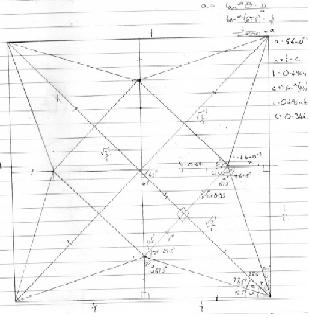
Finally, Scott from Pencoed Comprehensive extracted the key geometrical information very clearly in a good-sized and clear diagram (reduced in size here), so essential to any work in geometry: