Shut the Box
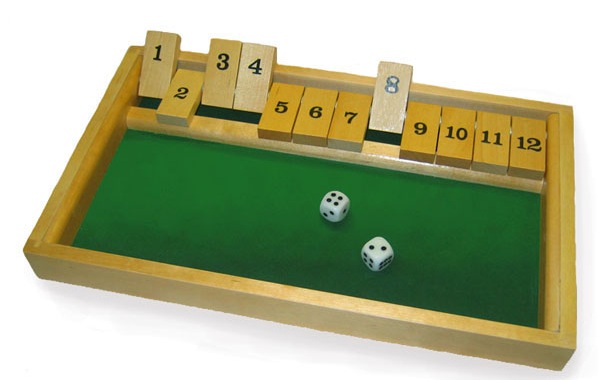
Here is a game that uses two dice and cards with the numbers 1 to 12 on them. The aim of the game is to turn over all the cards. You can turn over the cards that match the numbers on the dice.
Notes for adults
To play the game, start with the numbers showing on all the cards.
The first player rolls the two dice.
They can turn over the cards which are the same as the numbers rolled.
For example, if a $4$ and a $5$ is rolled, they would turn over the $4$ and $5$ cards. If a double is thrown, the player's turn ends. They can roll the dice again until they can't turn over any more cards. The cards that are left showing are then added and that is their score.
The dice are then passed to the next player who turns the cards the right way up again and then rolls the dice in the same way as player one. They now can keep on rolling dice as long as each time they can turn over some new cards. Remember that if a double is thrown, the player's turn ends. When the player can't turn over any more cards, those that are left are added together and that is the player's score.
The winner is the person with the lower score.
It can be played with just one turn each or each player can have a number of turns that you decide at the beginning of the game.
Here .doc .pdf are some cards which you could print out and cut up to play the game.
To play the game, start with the numbers showing on all the cards.
The first player rolls the two dice.
They can turn over the cards which are the same as the numbers rolled.
For example, if a $4$ and a $5$ is rolled, they would turn over the $4$ and $5$ cards. If a double is thrown, the player's turn ends. They can roll the dice again until they can't turn over any more cards. The cards that are left showing are then added and that is their score.
The dice are then passed to the next player who turns the cards the right way up again and then rolls the dice in the same way as player one. They now can keep on rolling dice as long as each time they can turn over some new cards. Remember that if a double is thrown, the player's turn ends. When the player can't turn over any more cards, those that are left are added together and that is the player's score.
The winner is the person with the lower score.
It can be played with just one turn each or each player can have a number of turns that you decide at the beginning of the game.
Here .doc .pdf are some cards which you could print out and cut up to play the game.
You can also play it on the computer using this interactivity.
Full screen version
This text is usually replaced by the Flash movie.
Notes for adults
Additional information about the interactive resource:
In variation $1$, you turn over the number shown on one or both dice.
In variation $2$, you turn over the value of both dice, their sum, or their difference.
In variation $3$, you turn over a combination of numbers that add up to the sum of the dice.
In variation $4$, you turn over a combination of numbers that add up to the product of the dice.
The "SCORE - SUM" uses scoring by adding the cards that are left.
The "SCORE - COCATENATE" uses scoring by reading the dice scores as digits in a two digit number.
Additional information about the interactive resource:
In variation $1$, you turn over the number shown on one or both dice.
In variation $2$, you turn over the value of both dice, their sum, or their difference.
In variation $3$, you turn over a combination of numbers that add up to the sum of the dice.
In variation $4$, you turn over a combination of numbers that add up to the product of the dice.
The "SCORE - SUM" uses scoring by adding the cards that are left.
The "SCORE - COCATENATE" uses scoring by reading the dice scores as digits in a two digit number.