Weights
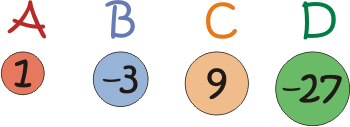
Imagine you have two of each of the 'weights' above.
Different combinations of the weights available allow you to make different totals.
Here are some examples:
$B + C = 6$
$B + 2C = 15$
$A + 2B + C = 4$
$2A + B + 2C + D =$ $-10$
The largest total you can make is $20$ (check you agree).
The smallest total you can make is $-60$ (again, check you agree).
Can you make all the numbers in between?
Can you show us how?
Is there always a unique way of producing a total, or can different combinations produce the same total?
Extension:
Imagine you are allowed just three different weights this time ($E$, $F$ and $G$), and at least one must be a negative weight, but you are allowed to have up to three of each .
For example, if you choose:
$E = 1$
$F =$ $-4$
$G = 5$
you can make $7$ and $-10$:
$E + F + 2G = 7$
$2E + 3F =$ $-10$
Choose your three weights and test out which totals you can make.
Which set of three weights ($E$, $F$ and $G$) allows you to make the largest range of totals with no gaps in between?
This problem is based on one of Don Steward's problems published by MEDIAN.
Don can be contacted at William Brookes School in Shropshire where he is now based.