Road Maker
We recieved two particularly full and clear
solutions to this problem. Both submitters thought carefully about
the precise mathematical meaning of the rules. The first solution
was from Patrick, from Woodbridge School and the second from Phil
at Garforth Community College. Both solvers correctly noticed that
the 'start tile' axiom was confusing due to the linguistic meaning
of start: could the start be found in the middle of a road? The
point of confusion about the meaning of the 'start' could be
clarified.
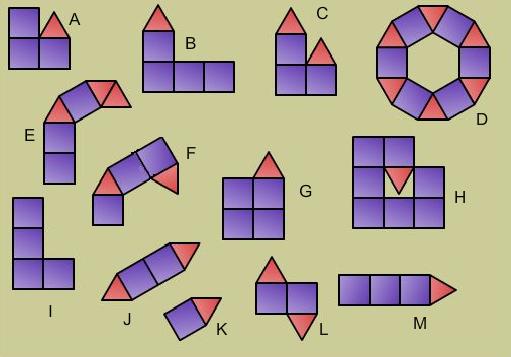
For a reminder, the roads are as
in the picture above and the rules are as follows:
1. Each road must contain a 'start' tile which is a blue square
aligned with its sides to the north, south, east and west.
2. Each road must contain an 'end' tile which is a red triangle. A
point on this triangle opposite an attached edge is called the
destination of the path.
3. Tiles in a road must be joined exactly along edges with no
overlap
4. Triangular tiles must point due north or due south. F and M both
have triangles which do not point north or south at all.
5. In a finished road, all tiles must be joined along an edge to
exactly 1 or 2 other tiles.
This first
solution correctly identifies the roads on the most 'obvious'
interpretation of the rules, but gives the two
possibilities
depending on the
interpretation of the 'start' tile:
These roads obey the all
rules:
A, B, D, E, H
Depending on the definition of
Start Tile , C could obey the rules if the start tile does
not have to be the beginning of the road, or it could not if the
start of the road (from which all tiles can be reached without
crossing one more than once) must be a square. L does the same.
D obeys the rules, as does E.
These roads disobey the
rules:
F disobeys rule 4,
G disobeys rule 5.
H obeys the rules.
I disobeys rule 2
J disobeys Rule 1, as does K.
M disobeys Rule 4.
Phil from Garforth Community College gave a
clear explanation as to which roads satisfied or broke each rule.
He thought like a true mathematician, questioning all rules
carefully. We were particularly pleased that he noted that
'touching corners' might count as an overlap; this would require
proper clarification.
The following roads fit all five
rules: A, B, E and H .
These roads break the rules as follows:
Rule1: It could be argued that L,
D and C break this rule, because there appears to be no distinct
start tile. It is ambiguous whether a distinct start is needed,
which only connects to one other tile, or simply a tile which could
be designated as the start .
Rule 2: Ibreaks this
rule, by having no red triangles, although D does not appear to
have a distinct destination, leading to a similar confusion as in
rule one .
Rule 3: All the tiles seem to
adhere to this law, although it could be argued that touching
corners such as the squares in H count as an overlap .
Rule 4: However, the meaning of
'point' is ambiguous. It could mean that any vertex of a triangle
should point north or south, or that the vertex opposite an
attached tile must point north or south. If this were the case,
then E and D would also break the rules .This is a good observation:
Rule 5: In G, there is one square
attached to three tiles .
Phil continued to analyse some more of the
struture of the problem:
Theoretically, there are in fact an infinite number of paths which
break only one of the rules. This comes from a loophole found in
rule number three:
"Tiles in a road must be joined
exactly along edges with no overlap"
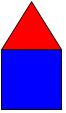
The following road would comply to the
munchkins'?? standards yes; this is the shortest road
None of the following, however, would:
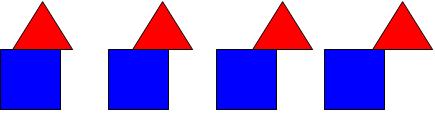
There is a start, a destination, the triangles point due north and
both tiles are only attached to one other. Those are only four of
the possible paths which break rule three, but the triangle can be
shifted by smaller and smaller amounts each time, leading to a
possible infinite number of combinations in the paths.
This probing of the rules to
see how they can be failed shows real mathematical insight -- well
done!