Overlaps
Overlaps
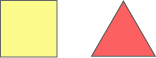
If I have these two shapes:
and I overlap them a bit, I get this:
The overlapped part looks like this:
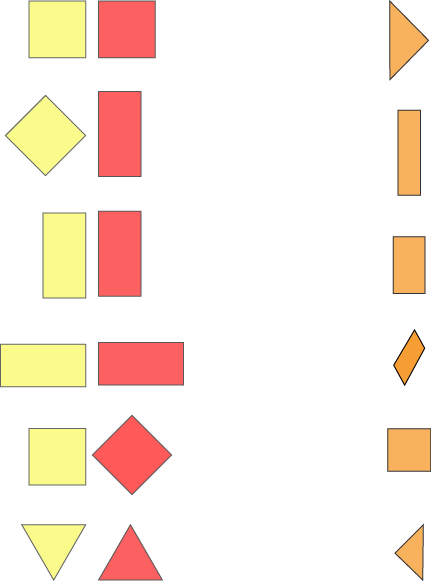
Can you match these pairs of shapes with the shape you would get if you overlapped them?
You may like to use this interactivity to test your ideas after you have tried imagining the overlap in your head.
Full screen version
This text is usually replaced by the Flash movie.
Why do this problem?
The main aim of
this problem is to encourage children to try to picture images in their heads and, in this particular case, the image might be a dynamic one. However, in this context, they will also be applying knowledge of properties of shapes and using language associated with 2D shape and space.
Visualising is a skill which can be invaluable in solving problems and this problem provides a good context for practising it.
Possible approach
Rather than showing the image of the equilateral triangle overlapping the square in the first part of this problem, you could ask children to shut their eyes and imagine the triangle moving over the square. This will give them time to really focus on their own image, rather than being presented with someone else's straight away. Invite them to talk to a partner about what they can see in
their mind's eye - what shape is the overlap? - and then talk about it as a whole group.
At this point, you could then show the image or use shapes cut out of tissue paper or overhead transparencies. You could then ask the class to work on the problem in pairs, perhaps using cut-out shapes to test their hypotheses and using the interactivity to bring ideas together as a whole group.
This sheet of the shapes and overlaps might be useful.
Key questions
What are the two shapes you are thinking about?
Looking at the overlap are there sloping sides? Which shapes could they have come from?
Possible extension
Learners could try this more complex version of this problem.
Possible support
Suggest cutting out the shapes from this sheet and drawing round them to make overlaps.