Shape Times Shape
We had some very well-reasoned solutions to
this problem - thank you to those of you who wrote a lot of detail.
Unfortunately there are too many of you to mention everyone by
name. Suryasnato from Limes Farm Junior School wrote:
The upside down isosceles triangle is 0 because every time it is in
a question it is the answer. The only number that rule applies to
is 0.
The diamond is 1 because every time it is in a question the other
number in the question is the answer. This can only happen if the
number is one.
The square is 2 because something cubed is equal to something. All
the numbers must be under twelve so the squares must be 2 or 1
because when those numbers are cubed, the answer is under twelve.
It can't be 1 because 1 cubed is one and the answer was a different
shape from the shape in the question. The semi-circle was 8 because
2 cubed is 8.
The oval was 4 because the second question on the left hand row was
2 times the oval is 8 and 2 times 4 is 8.
The circle is double the triangle because the rectangle times 4 is
equal to the circle while the rectangle times 2 is equal to the
triangle. Now we need to find a number and its double. It can't be
7 and 14 because all the numbers must be twelve or below. It can't
be five and ten because the triangle and the circle are in sums
which involve the 2 times tables and the 4 times tables and 5 isn't
in any of them. It isn't 4 and 8 because the semi-circle and oval
are those numbers and you can't have two different symbols which
are the same number. It can't be 3 and 6 because they aren't in the
2 or 4 times table. It can't be 2 and 4 or 1 and 2 because all
those numbers are other symbols. It also can't be 0 and 0 because
they are different symbols so they must be different numbers. The
only possible pair is 6 and 12 so the triangle is 6 and the circle
is 12.
The circle is 12 and the oval is 4 so 12 divided by 4 is the value
of the rectangle. 12 divided by 4 is 3 so the rectangle is 3.
The second sum on the top is rectangle times rectangle is equal to
something. Since the rectangle is 3, it is 3 times 3 which is equal
to 9. So the star with more sides is 9.
That leaves the hexagon and the other star. It says 2 times star
equals hexagon (see the second question on the right hand side) so
we have to search for a pair of doubles. The only remaining pair of
doubles under 12 is 5 and 10.
Alex and Bradley from Losley Fields
Primary did it in a very slightly different order again. They sent
in this Word document which
explains their thought-processes very well.
Rhiannon from St Mary Redcliffe Primary
also had a different way. She sent in this pdf
to tell us how she did it.
Some of you said that you worked out the
solution by trial and improvement - trying one number for a
particular shape to see whether it worked. That can be a useful
strategy although it might take a little longer than some of the
ways already described.
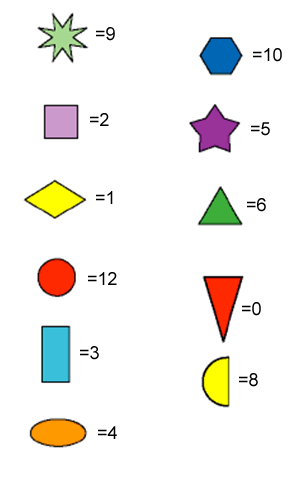
Here is a summary picture of the value of each
shape: