Temperature
-15C is 5 F
-65C is -85F
The answer to this problem is yes, there
IS a temperature where Celsius and Fahrenheit are equal, and it is
$-40$ degrees.
All the solutions to this problem took one
of three forms: trial-and-improvement, graphical or
algebraic:
This is how Samuel from Long Buckby Junior
School reasoned:
There is a temperature at which Celsius and Farenheit are the
same.
It is $-40$ degrees, because $9/5$ of $-40$ is $-72$ and $-72 + 32
= -40$.
I decided to look at negative numbers because starting with a
positive number and multiplying it by $9/5$ is going to increase it
and so is adding 32 so you're always going to end up with a number
greater than the number you started with.
However, if you start with a negative number, multiplying it by
$9/5$ decreases it, and adding $32$ increases it, so I realised
that with the correct number, Celsius and Fahrenheit might be the
same.
I decided to go down in tens:
$9/5$ of $-10 = -18$
and $-18 + 32 = 14$,
so that doesn't work;
$9/5$ of $-20 = -36$
and $-36 + 32 = -4$,
so that doesn't work;
$9/5$ of $-30 = -54$
and $-54 + 32 = -22$,
so that doesn't work.
But $9/5$ of $-40 = -72$
and $-72 + 32 = -40$ so it works.
The reason it works is because multiplying by $9/5$ is equivalent
to adding $4/5$ of it, and for $-40$ adding $32$ is equivalent to
subtracting $4/5$ of it (because $32$ is $4/5$ of $40$).
Because of this, Farenheit and Celsius are equivalent ONLY at
$-40$ degrees.
The Four Mathemateers from Brocks Hill
Primary School also used a trial and error approach, as displayed
here:
First we started going down in tens of Celsius from $0$, and we
found out a pattern:
the difference between F and C was getting closer by eights every
time.
When we got to $-30C$ the difference was only $8$. So $-30$C is
equal to $-22$F.
Then we tried $-40$C and found out that $-40$C was the same as
$-40$F.
So the answer is $-40$.
Yesuhei used a similar
strategy:
First I tried different solutions for Celsius like $-50$ and
that gave me $-58$ Fahrenheit .
Then I tried $-45$C because whenever you go down (negative
increasing) the F and C's distance increases. That gave me $-48$
Fahrenheit which was very close, so I tried $-40$ Celsius and that
gave me $-40$ Fahrenheit.
Others who found the correct answer by
this method are Emma and Chloe from The Mount School and Michael
from Bilton School.
Beatrice fron Raffles Girls' School and
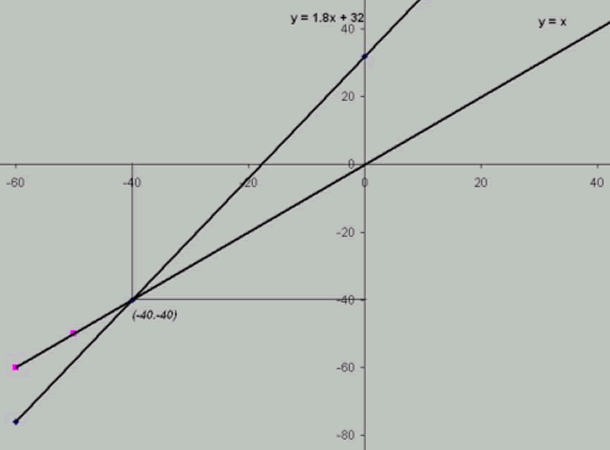
Michael used a graphical approach.
Michael's answer is shown
here:
I plotted the lines of the simultaneous equations against each
other and found where they crossed.
In the graphs $y =$ F and $x = $C.
The quickest way to solve this problem is
with an algebraic approach, and both of the people who used graphs
used this approach as well. The other people that obtained the
correct answer by this method include Sugam and Fiona from The
Mount School, Chris from CCSN, Samantha from The Steele School,
Gemma, Griselda and Charlie from Colyton Grammar School, Jasvir,
Matt and Christian from Kingshill, Ed from Tunbridge Wells Grammar
School for Boys, Stephen and Joe from Singapore International
School, Kieran from Alcester Grammar School and
Pradeesha:
Here is Sugam's working:
Let x be the temperature where Fahranheit and Celsius are
equal.
$x=\frac{9}{5} x+32$
$5x = 9x + 160 $
$-4x = 160 $
$x = -40 $
Therefore $-40$ Celsius $= -40$ Farenheit
And here is Michael's
solution:
To solve it algebraically I can create two simultaneous
equations:
$F = C$
$F = 1.8C + 32 $
Therefore
$C = 1.8C + 32 $
$C = -32 / 0.8 = -40 $
And here is Kieran's
solution:
Using the equation, $F=\frac{9}{5} C+32$,
we can remove the fraction by multiplying both sides by
five.
Doing so produces $5F = 9C + 160$, and thus, using the sought
after equation of $F = C$,
we may further deduce that, since $5F and 5C$ are one and the
same, subtracting the two equal amounts from either side
leaves
$0 = 4C + 160$
or $4C = -160$
or $C = -40$
Consequently, $-40$ Celcius is the same as $-40$ Fahrenheit.
Oliver remembered to check that his
solution worked:
We can substitute $-40$ as $C$ in $F = 9/5C + 32$ to check our
answer
As $-40 = -72 + 32$, our answer is correct
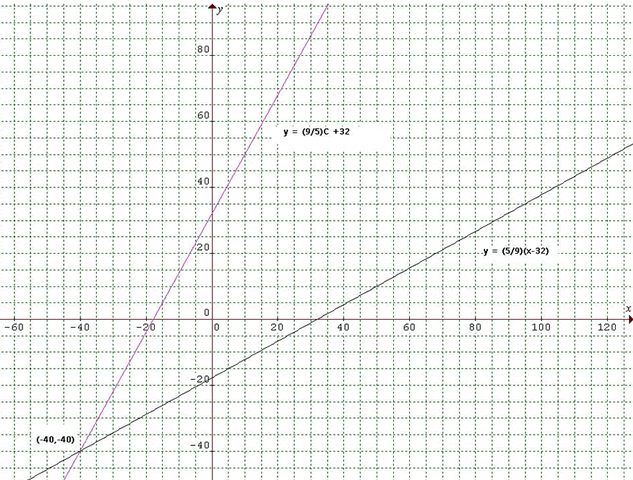
Beatrice combined an algebraic and
graphical approach:
We know that $F = (9/5)C + 32$ [equation 1]
This is a linear equation, because it follow the structure $y =
mx + c$
Now let us make C the subject:
$F = (9/5)C + 32 $
$F - 32 = (9/5)C$
$C = (5/9)(F - 32)$ [equation 2]
Now plot equations 1and 2 on Graphmatica.
They will intersect at the point $(-40,-40)$.
So we know that $-40F = -40C$.
Well done to all of you who solved this
problem correctly.
Short solution:
1. Is there a temperature at which Celsius and Fahrenheit
readings are the same?
Yes, -40°C
= -40°F
2. Can you describe a way of converting Fahrenheit readings into
Celsius?
$C = (F-32):1.8$ where C is a temperature in Celsius and F is
the temperature in Fahrenheit.
3. Can you describe a way of converting Celsius readings into
Fahrenheit?
$F = 32+1.8C$
4. Is there a temperature at which the Fahrenheit reading
is
20 degrees higher than the Celsius
reading? Yes, -15°C = 5°F
5. Is there a temperature at which the Celsius reading is
20 degrees higher than the Fahrenheit
reading?
Yes, -65°C = -85°F
6. Is there a temperature at which Kelvin and Fahrenheit
readings are the same?
Yes, 574.6°K = 574.6°F
7. Is there a temperature at which Kelvin and Celsius readings
are the same?
No
8. Can you describe ways of converting Kelvin readings into
Fahrenheit and Celsius readings?
F = 32 + 1.8(K-273.15) and C = K - 273.15 where K is the
temperature in Kelvin.