Making Longer, Making Shorter
Making Longer, Making Shorter
First, Ahmed used interlocking cubes to make a rod four cubes long:

How many cubes did he need to make a rod twice the length of that one?
How many cubes did he need to make one three times the length?
How many cubes did he need to make one four times the length?
How many cubes did he need to make a rod half the length of his first one?
How many cubes did he need to make a rod a quarter of the length of his first one?
These rods are the ones Ahmed made:
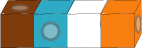





Which one is twice the length of Ahmed's first rod?
Which one is three times the length?
Which one is four times the length?
Which one is half the length of his first rod?
Which one is a quarter of the length of his first rod?
Which one is the same length as his first rod?
Why do this problem?
This problem brings in doubling, halves and quarters in a very practical way using rods made from interlocking cubes. It gives children a practical context in which to explore simple multiplying and dividing, even if these particular terms are not used explicitly. It can provide a very useful context for introducing and using the vocabulary of halves
and quarters.
Having multilink cubes for each child is essential.
Possible approach
You could start with the children on the carpet with fairly free play making rods of different lengths. Alternatively, you could begin with the problem on the computer and ask the class each to make a rod four cubes long. It might be best, if it is possible, to work on this problem with a small group of children so that you can listen carefully to their conversations. Encourage them to
explain how they know a particular rod is, for example, twice the length of the four-cube rod.
When some four-cube rods have been made you could ask the questions given in the problem getting the children to make the rods as you go along:
Make a rod twice the length of that one.
Make a rod one three times the length.
Make a rod one four times the length.
Make a rod a rod half the length of the first one.
Make a rod a rod a quarter of the length of the first one.
They could then identify rods (as in the problem itself) as being twice the length of the first rod, and then three times the length, four times the length, half the length, a quarter of the length, and the same length as the first rod.
After this children could work in pairs making the rods again and recording what they have done on squared paper. Suggest that they work with each other when a difficulty arises rather than seeking your help immediately.
At the end they could show the rods and their illustrations as an opportunity for you to reinforce the vocabulary that you have been using. Some children may count cubes and rely on their knowledge of number bonds or multiplication facts, others may use the cubes to make different rods using a system of trial and improvement along with counting.
Key questions
If Ahmed's second rod is twice as long as the first, how many of his first rod did he need to make it?
If Ahmed's third rod is three times as long as the first, how many of his first rod did he need to make it?
If Ahmed's fourth rod is four times as long as the first, how many of his first rod did he need to make it?
If Ahmed's fifth rod is half as long as the first, how could he break his first rod to make it?
If Ahmed's sixth rod is a quarter of the length of the first one, how could he break his first rod to make it?
How do you know that rod is twice the length of the four-cube rod?
Possible extension
Learners could investigate halves and quarters of other length rods using multilink.
Possible support
Having the cubes available to make the rods will help all children access this problem.