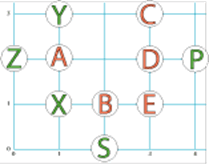
Then I saw the clue that said that (3,3),
(3,2) and (3,1) are all consecutive in the alphabet, because the A
and the Z are already used, it has to be C, D and E because it says
that (3,3) is made of only curved lines.
Then I saw that one of the clues said
that (2,0) is only made of curved lines, so (2,0) is the S.
(4,2) is not symmetrical in any way so (4,2) is a P.
The first clue says that (1,1) and (1,3)
have a vertical line of symmetry, another clue says that (1,1) also
has a vertical line of symmetry, which means that (1,1) is a X and
(1,3) is a Y, which leaves the B which is at (2,1) because a clue
says that at (2,1) there is a letter with a horizontal line of
symmetry.
Many children from
Stradbroke Primary School sent an image of their solution. Here is
George's: