Modular Knights
This problem was a toughnut for a while
before we received solutions from several students.
Max Whittaker from Culford School, Jose,
Carlos , Dan and Sam from Ickford Combined School, Issy and Audrey,
also from Ickford combined school, all sent in their methods of
solution in certain cases. This involved starting in a certain
place and moving around the board systematically.
Alex from Darell Primary School
gave an explicit solution:
First you need to have these settings:
knight moves round: 2 in/out:
1 board sectors: 3 tracks: 3
Here is what you should do in the exact order, there may be other
ways, but here is what I did.
Bottom/middle right
Inner left
Top right
Inner bottom right
Far left
Bottom right
Then finally, Far/middle left
Ben from Kenny School gave a great
description of his mathematical thinking about this analysis of
this problem which we like very much: it really highlights the
creative side of mathematical problem solving.
Ben uses the notion of coprime numbers (two
whole numbers which share no common factor except 1) to make some
inroad into the analysis of the problem .
Ben cleverly represented the board as a
rectangle with opposite sides identified, which makes visualising,
and therefore analysing, the situation much easier.
If the grid is $p$ by $q$ and the knight
can move $a$ across and $b$ down then Ben suggests that the journey
is possible if at least 2 of the following conditions are
true
- $a (\mbox{ mod } p)$ is coprime to $p$
- $b (\mbox{ mod } q)$ is coprime to $q$
- $b (\mbox{ mod } p)$ is coprime to $p$
- $a (\mbox{ mod } q)$ is coprime to $q$
This is a great start, but not quite the
whole story as some grids with coprime values are not coverable,
although many are.
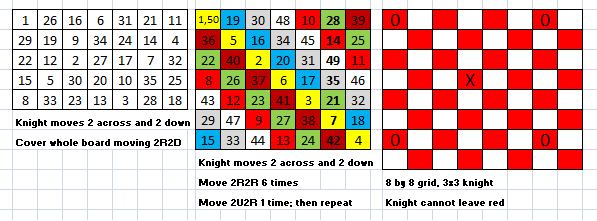
To make a little more progress,
imagine that the grid has $p$ rows and $q$ columns, with $p, q$
coprime and $q> p$. Suppose also that the knight moves $a$
across and $b$ down each time, where $a$ is coprime to $p$ and $b$
coprime to $q$. Then each of the first $q$ squares will land
on a different column of the grid ; therefore the knight will not
have revisited any squares yet, although it will have revisited
$q-p$ rows. If $q-p$ is coprime to $p$ then this procedure will
fill the whole grid. If not, then the knight will need to change
direction at some point to have a chance of filling the grid
without hitting another square more than one.
To proceed note that if the knight always moves in the same
direction it positions will be of the form $(na \mbox{ mod p} , nb
\mbox{ mod q}) $.
For a location to be repeated, for some $n$ and $m$ we would
have
$$
(na \mbox{ mod p} , nb \mbox{ mod q}) =(ma \mbox{ mod p} , mb
\mbox{ mod q})
$$
For this to hold we would have
$$
((n-m)a \mbox{ mod p} , (n-m)b \mbox{ mod q}) =(0, 0)
$$
Since $a$ and $b$ are coprime to $p$ and $q$ respectively this
implies that
$(n-m) = Np$ and $(n-m)= Mq$ for some non-zero integers $N$ and
$M$. Since $p$ and $q$ were chosen to be coprime and different we
must have $N = Rq$ and $M=Rp$ for some other non-zero integer $R$.
Thus $(n-m)$ is a non-zero multiple of $pq$. Since there are only
$pq$ squares in the grid we see that the knight cannot have
revisited any squares.