Help
You may find it useful to download one of the following booklets which give an overview of NRICH:
Primary (Stages 1&2)
Secondary (Stages 3&4)
Post-16 (Stage 5)
Each booklet is designed to be printed doublesided onto A4 paper, then folded in half to make a multi-page A5 booklet. Please remember to choose the 'Short-side binding' option when printing doublesided (otherwise text on reverse pages will appear upside-down!).
Here is a flyer showing the latest developments on the site.
Introduction
Each month we publish fifteen problems and a number of games, articles and other resources, designed for use by maths students from the age of 5 to 19. All are tagged with curriculum content links and challenge levels.
We do not include solutions to problems in the month in which they are first published but we do encourage students to send us their solutions. We edit and publish extracts from them in the following months. The deadline for submission of solutions is the 21st of the month.
Below are more details on how to find problems that may be most appropriate for you.
Stages and curriculum content
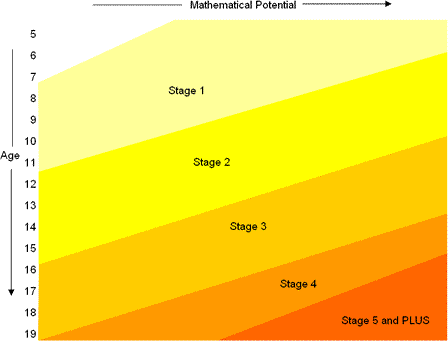
The five maths content stages correspond to UK Key Stages, but for international users the following gives an indication of the ages by which the mathematics involved in the problem will usually have been met:
- Uses mathematics you would normally meet before the age of 8
- Uses mathematics you would normally meet before the age of 11
- Uses mathematics you would normally meet before the age of 14
- Uses mathematics you would normally meet before the age of 16
- Uses mathematics you would normally meet post 16
Some mathematical content is not found in many normal school curricula but this is included at a stage that we feel is appropriate to its application.
Challenge level
The level of maths challenge is indicated by a scale of one, two or three stars.
| * |
Problems that require some initial investigation and planning, |
| ** |
Problems that extend pupils beyond normal curriculum demands and which challenge students working at the next stage, |
| *** |
Very challenging problems. |
The chart gives some guidance on which problems may be most appropriate for pupils at various ages and abilities:
A problem will include:
- A question (text)
- Resources
- Still picture(s) or diagram(s)
- Problem specific interactivity (where appropriate)
- Hints for pupils
- Notes - designed mainly for teachers, parents and mentors
- Curriculum links, which you can use when searching for particular resources.
Solutions*
We will publish the names of up to three pupils or groups of pupils (chosen using the method of "first out of the hat") who submit solutions which make a significant contribution to the published edited solution.
* We recommend that teachers encourage pupils to submit joint solutions and/or filter solutions before they are sent to us, acknowledging pupils' efforts within the school.
The structure of each month's publication
The site is published in four sections containing overlapping stages. Each of the four sections include maths problems and resources that are focussed at particular curriculum content (described above) and listed below :
- Stages 1 and 2
- Stages 2 and 3
- Stages 3 and 4
- Stages 4 and 5
The purpose of publishing in this way is to offer as much flexibility to learners and teachers as possible and to discourage the view that a problem that uses curriculum content at Stage 2 is inappropriate for learners working at stages 3 or 4 (or even 1). There are three main reasons for this:
- Firstly we learn at different rates, and this means that a problem which uses mathematical content normally associated with one particular stage can often successfully enable a fresh grasp of that same content at a different stage.
- The problems are designed to promote problem solving and investigative mathematics. The development of this type of thinking is not tied to levels of content knowledge.
- Finally, the problems within each stage cover between them a full range of challenge levels. A problem with a lower challenge level might offer opportunities to introduce mathematical ideas to students ahead of that content being taught in the "normal curriculum". Similarly problems at the highest challenge level can test the problem-solving skills of the most able mathematicians, despite the
mathematical content resting on ideas normally met at an earlier stage.
What is a problem?
Problems can have one or more purposes:
- some are designed to encourage pupils to develop mathematical thinking and problem-solving skills by applying their knowledge to novel, interesting and challenging situations,
- some problems offer opportunities to learn some new mathematics as learners work through the problem-solving process,
- others require problem solvers to bring together a range of mathematical ideas and techniques in order to make progress.
Many of the problems on the site have the capacity to be extended well beyond the basic task and should be seen as a starting point for maths investigation and discovery. The notes supplied with new problems give some ideas on mathematical content and potential. Hints are there to support pupils who are finding it hard to get started.
Problems are designed to meet the needs of pupils from 5 to 19. They are classified according to maths curriculum content stage and level of challenge.