Real(ly) Numbers
Alan of Madras College, St Andrew's and Tom of
Bosworth College, Desford, Leicestershire, sent in really elegant
solutions to show the maximum value taken by any one of these
variables.
Firstly
Alan's solution
Consider the function,
$$f(a) = (a - x)(a - y)(a - z)$$
which has the real solutions, $a = x$, $a = y$ and $a = z$. when
$f(a) = 0$.
$$\eqalign{ f(a) &=& a^3 - (x + y + z)a^2 + (xy + yz + zx)a
- xyz \\ \; &=& a^3 - 5a^2 + 3a - xyz}$$
Differentiating with respect to $a$ (where $x$, $y$ and $z$ are
constant in respect to $a$),
$$\eqalign{ f`(a) &=& 3a^2 - 10a + 3 \\ \; &=& (3a
- 1)(a - 3)}$$
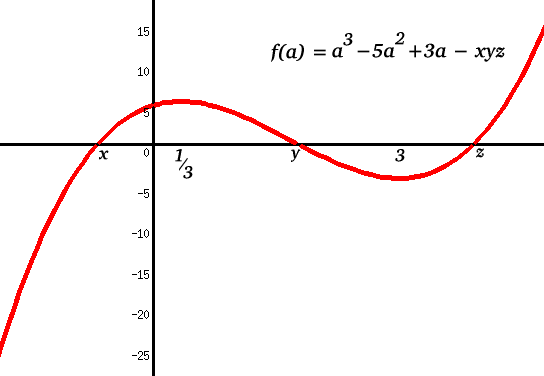
This gives the coordinates of the turning points of the graph as $a
= 3$ and $a = 1/3$. As $x$, $y$ and $z$ are real, the solutions of
$f(a) = 0$ must also be real, which gives:
$$x \leq 1/3 \leq y \leq 3 \leq z$$
-
- Considering the graph, which cuts the horizontal axis in
a = x , a = y and a =
z , in order to make z as large as possible the
graph is dropped down as far as possible making x =
y = 1/3 and z = 13/3.
Thus 13/3 is the maximum real value of one of the solutions of
f ( a ) = 0 which corresponds exactly to the
given equations, that is 13/3 is the maximum real value for any of
the variables where all three satisfy the given equations.
The same method gives the minimum value . By lifting the graph
the minimum possible value of x is made to occur when
y = z = 3 which gives x = -1. So
x = -1 is the minimum real value possible for any of the
variables satisfying the given equations.
Tom uses a different method. He treats the two
equations as simultaneous equations and one of the variables as if
we know its value. Since the variables are interchangeable, this
can be any of them. We can choose one of the variables to be bigger
than the others and the limits we obtain on this variable can be
applied to all of them.
Here is Tom's solution to the
problem
We have $x+y+z=5$ so taking $y=5-x-z$:- $$\eqalign{ xy + yz + zx &= 3 \\ x(5-x-z) +z (5-x-z) +zx
&= 3 \\ z^2 - z(5 - x) - (5x - x^2 - 3) = 0 }$$
- As z is a real number we use the condition for this quadratic
equation to have real solutions:
- $$25 - 10 x + x^2 + 20 x - 4 x^2 - 12 = 13 + 10x -3x^2 \geq 0
.$$
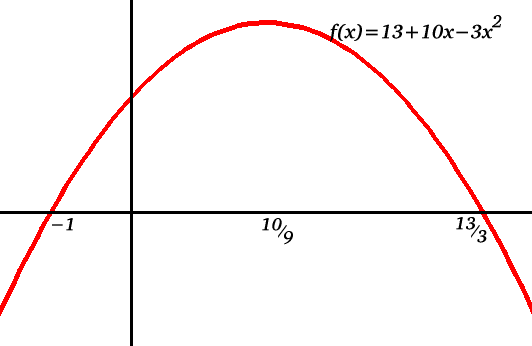
- This tells us the range of possible values for $x$. Looking at
the graph of the function: $f ( x ) = 13 +10 x - 3 x^ 2$, we see it
cuts the axes at (0, 13) (-1, 0) and (13/3, 0) and has its maximum
value when $x = 10/9$.
-
So 13/3 is the maximum value any of the numbers can take and -1
is the minimum value any of the variables can take.