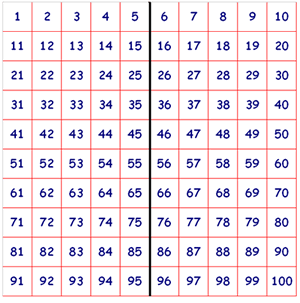
Thank you for your solutions to this problem. You found several different ways of tackling it.
Mikey from Archbishop of York CE Junior School wrote:
Having printed the page out I realised that if you turned it over you could see through the page. Looking where $100, 58, 23, 19$ would be meant you could read off the answers as $91, 53, 28, 12$. Or is this cheating?I don't think this is cheating at all Mikey! Mikey then realised something else which was also spotted by "N" (he or she didn't give us a full Christian name):
If you draw a mirror line down the middle of the square you will be able to work out what number will be behind each number. You choose a number, then find its mirror on the other side of the line, this 'mirror' number will be the number on the reverse!This is also a very handy method - well noticed. "N" sent an image with the "mirror line" drawn in:
Devonshire Maths Club, Devonshire Primary School have found a pattern which they describe:
Very well noticed. Well done!