The difference is 2 when we have 4 consecutive numbers:
x (x+3) = x2 + 3x
(x+1) (x+2) = x2 + 3x + 2
The difference is 3 when we have 5 consecutive numbers:
x (x+4) = x2 + 4x
(x+1) (x+3) = x2 + 4x + 3
The difference is 4 when we have 6 consecutive numbers:
x (x+5) = x2 + 5x
(x+1) (x+4) = x2 + 5x + 4
The difference is (n-2) when we have n consecutive numbers:
x (x+n-1) = x2 + nx - x
(x+1) (x+n-2) = x2 + nx - x + n - 2
We received many correct solutions to Pair Products, including some with clear explanations from Jiaixang from St George's School in Harpenden, Keone from Sage Ridge School (Reno, NV), Gabriel from the British School of Brussels, Natasha from the European School, Aisling from Grand Avenue Primary School, Benjamin from Woodbridge School and Rebekah from Bayhouse School in Hampshire.
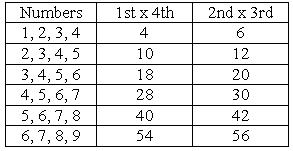
Emily tried out some examples:
There are two patterns going on. The $2$nd $\times$ $3$rd is two more than the $1$st $\times$ $4$th and this always happens. This is because both of those columns are going up in the same way. You do $+6$, then $+8$, then $+10$ and so on, adding the next even number.
Keone found that with four consecutive whole numbers:
The product of the first and last numbers is always $2$ less than the product of the middle two numbers.
Explanation: Suppose the first number is $x$. Then the second number is $x+1$, the third is $x+2$, and the fourth is $x+3$.
So the product of the first and fourth numbers is $x(x+3) = x^2 + 3x$.
Also, the product of the second and third numbers is $(x+1)(x+2) = x^2 + 3x + 2$.
So $(x+1)(x+2) = x(x+3) + 2$ for any chosen value of $x$.
With five consecutive whole numbers he found that:
The product of the first and last numbers is always $3$ less than the product of the second and fourth numbers.
Explanation: Again, let the first number be $x$; then the second number is $x+1$, the third is $x+2$, the fourth is $x+3$, and the fifth is $x+4$.
So the product of the first and last numbers is $x(x+4) = x^2 + 4x$.
Also, the product of the second and fourth numbers is $(x+1)(x+3) = x^2 + 4x + 3$.
So $(x+1)(x+3) = x(x+4) + 3$ for any chosen value of $x$.
And with $n$ consecutive whole numbers he found that:
The product of the first and last numbers is always $n-2$ less than the product of the second and penultimate numbers.
Let us consider the general case where there are n consecutive whole numbers.
As before, let the first number be $x$; then the second number is x+1, the third is x+2, and so on.
The last number (the $n$th number) will be $x+n-1$. Thus, the penultimate (second-to-last) number will be $x+n-2$.
So the product of the first number and the last number will be $x(x+n-1) = x^2 + nx - x$
The product of the second and the penultimate numbers will be $(x+1)(x+n-2) = x^2 + nx - 2x + x + n - 2 = x^2 + nx - x + n - 2$
So $(x+1)(x+n-2) = x(x+n-1) + n - 2$;
that is, the product of the second and penultimate numbers will always exceed the product of the first and last numbers by exactly $n - 2$.
For example, if we take 6 numbers, the product of the $2$nd and $5$th numbers will be $4$ more than the product of the $1$st and last numbers.
Natasha generalised her findings in a similar way and then went on to check her conclusion:
We can generalise this problem by substituting particular numbers with letters.
Let the first number be $a$.
If there are $n$ numbers, where a is the first, then the last number is $(a+n-1)$.
The second number is $(a+1)$, the penultimate number $(a+n-2)$.
By multiplying the first and last numbers together, we get $a(a+n-1) = a^2 +an-a$
Multiplication of the second and penultimate numbers gives
$(a+1)(a+n-2) = a^2+an-a+n-2$
The difference therefore in the product of the first and last numbers and the product of the second and penultimate numbers is always $n-2$.
For added confirmation we can take a random example:
Consider the numbers $56, 57, 58, 59, 60, 61, 62$
where $n = 7$ and $a = 56$
Our general formula tells us that the difference in the product pairs should be $n-2$ (i.e. $5$).
When we do the calculation, we get
$$57 \times61 - 56 \times62 = 3477 - 3472 = 5$$
This result corresponds with the general one established above.
Tom explained it a different way:
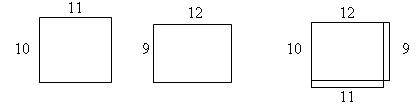
If we overlap the two rectangles we cut a piece off at the bottom and create a new piece at the right hand side. The difference between the two small rectangles is always two. This works for all numbers, not just $9, 10, 11, 12$.
We received a slightly different summary of findings from Aisling:
The multiple of the first and last numbers of a series of consecutive whole numbers, is the same as the multiple of the second and penultimate numbers of that series, minus the number of numbers separating the first and last numbers.
Well done to you all for such clear reasoning.