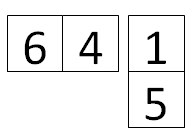
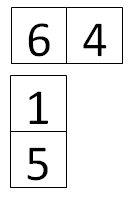
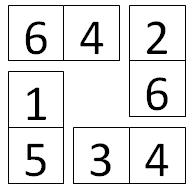
4 Dom
Well done to all of you who found a
solution to this challenge. Chloe and Mia from Scotts Primary
School both managed to solve this challenge whilst in competition
with Mrs Briggs, the teaching assistant. They both finished really
quickly apparently and were really pleased with themselves (quite
rightly!). Their teacher, Miss Lilley, and the rest of
the class were very proud of them!
Zareah from St Joseph's Convent gave us
some good general advice:
You just need to even it out. Don't put all the larger numbers in
one corner and all the smaller numbers in another corner. Put a
small number with a large number and soon you'll get it out!
Milo and Darren from SVS used a similar
method to Zareah. Angus from West Linton Primary used this strategy
for solving the problem:
First I added up the dots ($5+1+6+4+2+6+4+3=31$) then divided it by
$4$ to find the average dots on a domino.
There are one and a half dominoes in a side.
$31\div4 =8$ (roughly)
$8\times 1\frac{1}{2}= 12$
Then I fitted $12$ domino spots into each side.
What a good idea, Angus. This estimation
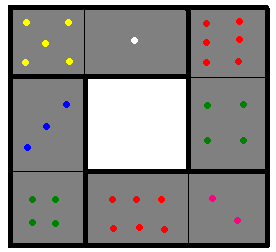
really helped you! Here is Angus' picture of the
solution:
Lisa, who didn't give her school,
described a very convincing way of working out the
solution:
This is the lowest side total possible using the domino with the
highest total: $6+4+1=11$.
The sides can therefore not add up to less then $11$.
However, for the $5+1$ domino to be part of a side totalling $11$,
there would need to be another $5$. Because there is not another
$5$ the lowest possible total of the sides is $12$.
This is the highest total possible using the domino with the lowest
total: $5+1+6=12$.
Combining this with the information we already have, we know the
sides must add up to $12$.
It is now simply the case of working out the number needed to make
$12$.
$6+4+2=12$ There is only one $2$, so this domino must go
here.
$6+2+4=12$ The remaining domino must therefore be placed this way
round.
$3+4+5=12$ If the $5+1$ domino was the other way round it would
need to be rotated to make the final side add up.
Very well explained, Lisa. We can see
that this is the same solution as Angus', just rotated. A pupil
from Wootton Upper School had a slightly different
method:
Part 1: How many dots on each side?
The arrangement shows that each side of the square is composed of
the sum of both sides of a single domino plus one of the sides of
another domino.
The sum of the dots on each single domino is as follows: ($5$,$1$)
= $6$, ($6$,$4$) = $10$, ($4$,$3$) = $7$ and ($6$,$2$) = $8$.
Therefore, the smallest sum possible is $8$ i.e. $6$ (from $5$,$1$)
+ $2$ (from $6$,$2$) whereas the largest sum possible is $16$ i.e.
$10$ (from $6$,$4$) + $6$ (from $5$,$1$).
She then conjectured that, since the four sides of the square must
have equal numbers of dots, a compromise of the extreme values is
needed so each side could total $12$ dots.
Part 2: Arrangement
The ($5$,$1$) domino needs a $6$ from one side of another domino
since $6 + 6 = 12$
Similarly, ($6$,$4$) needs a $2$ as $10 + 2 = 12$
($4$,$3$) needs a $5$ as $7 + 5 = 12$
($6$,$2$) needs as $4$ as $8 + 4 = 12$
For $6 + 6$, the $6$ can be obtained from ($6$,$4$) or
($6$,$2$)
For $10 + 2$, the $2$ can only be obtained from ($6$,$2$)
For $7 + 5$, the $5$ can only be obtained from ($5$,$1$)
For $8 + 4$, the $4$ can be obtained from ($6$,$4$) or
($4$,$3$)
Looking back at the square, it should be acknowledged that the
dominoes are connected from head to tail like a chain. This is what
we need to do with our numbers - arrange them so they form a nice
chain.
For the above reason, we use ($6$,$4$) to obtain the $6$, and
($4$,$3$) to obtain the $4$ so that each domino is linked up
consistently and they all get their required number of dots to
total $12$.
The result obtained should be: ($6$,$4$) - ($2$,$6$) - ($4$,$3$) -
($5$,$1$) - ($6$,$4$) etc.