Halving
Halving
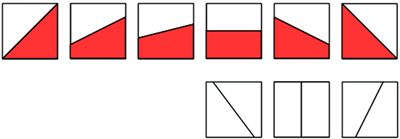
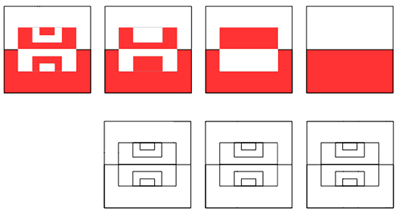
These images show squares split in half:
How might you check that each was correct?
Can you think of more ways to split a square into two halves?
You might like to use squared paper to draw your ideas on or to print out the uncoloured squares above.
Why do this problem?
This exploratory problem is a fantastic way to consolidate children's understanding of halving and halves. It also gives learners experience of mathematical proof.
Possible approach
To introduce the problem, you could use
this PowerPoint presentation. It shows squares being divided in different ways and would provoke interesting discussion. (It loops so starts again when it reaches the end.) You may want to show the images in turn and after allowing some time for them to talk in pairs, ask children to
raise their hands if they think the squares are divided in half. This allows children to clarify their understanding of halving before going on to the main task.
It would be a good idea to give pairs of children a print-out of
these sheets , the first of which contains the smaller squares, and the second the larger squares in the problem. Pupils will have many ideas of their own when it comes to checking or proving that the squares in the problem really are split in half. Some will be able to
explain orally, in terms of looking for red and white parts that are exactly the same shape and size. Others will prefer to draw them on squared paper and count squares. Some may want to cut out the squares and physically lay the halves on top of each other. Alternatively, it might be possible in some instances to cut out the square and fold it to show that it has been split in half. Learners can
use the uncoloured squares on the sheet to investigate different ways of shading halves.
In the plenary, as well as giving the class a chance to share their solutions and ways of working, you might like to distinguish between the squares that have been divided into two pieces (one red, one white) from those where there are more than two pieces. In all cases, we are comparing the total amount of red with the total amount of white.
Key questions
Have you thought about drawing the squares on squared paper and then using the small squares to help you check that they are split in half?
How about cutting out your square? How would this help to check that you had divided it in half?
Possible extension
Some children might enjoy investigating how to split other shapes in half.
Possible support
This sheet has the larger squares drawn on a grid of squares which may be useful for many children.