Calendar Patterns
temp-notes
This investigation would work well with the children in pairs, each
pair with their own copy of the December calendar section. It might
be helpful to supply them with a paper frame to isolate the set of
four numbers. This can easily be slid around the calendar to find
new sets of four.
The problem begins with the lowest set of numbers simply to make
the addition tasks easy. Later in the investigation encourage the
children to move to the largest numbers they can cope with. The
children should soon notice that the diagonally opposite pairs have
the same total. Ask the children to make a note of the total of all
four numbers as they gradually move down (or across) the calendar.
Patterns will emerge.
If appropriate, guide the children to try multiplying the numbers
and looking for patterns. If the children understand the basic
concept of multiplication but can't readily manage the
calculations, using calculators would be appropriate.
This investigation could be revisited several times, trying
different approaches each time. Encourage the children to discuss
discoveries and suggest new things to try. For example, what
happens if the square box is enlarged to include nine numbers, or a
rectangular frame of six numbers? Test discoveries on other
months.
Further explorations can be made by changing various parts and
carrying out more investigative work.
Here we see what happens when we pretend to have a four-day week
and take our block to be 4 by 4. The multiplication is done as
follows;
[multi 4x4]

This forms the first block of answers in the following table. The
table also includes some other pretend weeks. The answers to the 6
multiplications that can be done around the 4 by 4 square are then
shown, as well as the digital roots of these answers.
[blocks of 4]
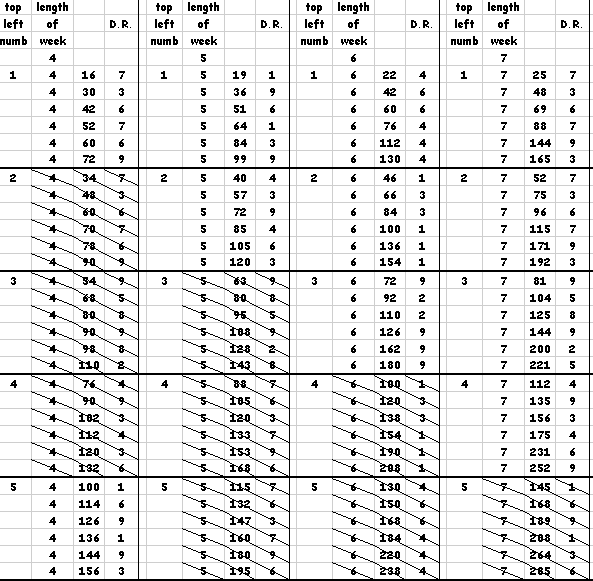
Some of the blocks of 4 by 4 would not work because of the short
weeks - they are shown with hatching. The numbers 1 to 5 show the
starting number for each 4 by 4 block.
Having given you this starting point, pretend weeks of different
lengths could be explored in a similar way. I found it very
worthwhile to explore the digital roots that resulted.
You can then change the size of the blocks and continue with more
investigational work.
When working with your pupils in opening out a challenge it's
really good to get some first results from a change in the question
and then ask the pupils, "what do you see?". Then it's a matter of
being brave enough to follow some of those leads and not just push
for what you have seen. You'll probably be very surprised about all
the different things that come up which may lead to further
investigations.