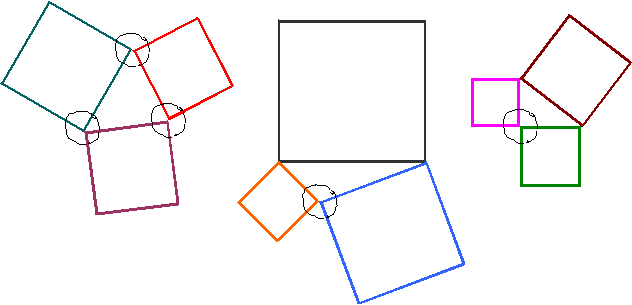
Here are some experiments in which you can make discoveries about geometry.
You need about six thin straight sticks or thin drinking straws. Cut one into 3 bits. Can the bits form a triangle? It is not always possible to make a triangle using three given lengths. Experiment with sticks or straws of different lengths and try to find the condition which determines when three lengths do form a triangle and when they do not. This condition is called the Triangle Inequality .
You now need square paper bits (laminated ones preferably) ranging from 1 x 1 to 13 x 13 squares. Ideally the squares should be plain on one side and have squares marked on the other side.
Instead of using sticks, make triangles with the edges of three square bits of your choice using the plain sides. Every time you make a triangle, identify whether it is acute, obtuse or right angled and fill in the first column in the table.
Recall that a triangle is acute when each of its angles is less than a right angle or square corner. A triangle is right angled when one of its angles is a right angle or a square corner. A triangle is obtuse when one of its angles is greater than a right angle or square corner.
Sometimes you get acute angled triangles, sometimes right angled and sometime obtuse angled. Now turn over the squares showing the grids.
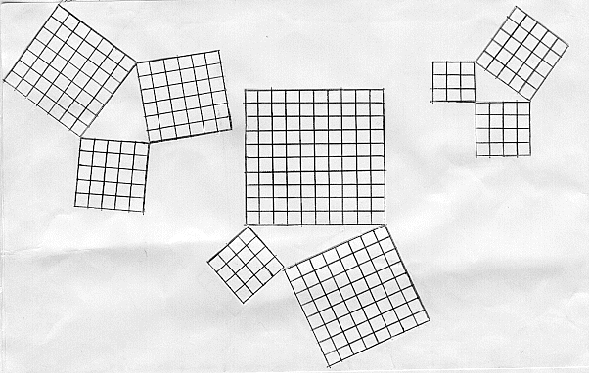
Use the paper squares to make different triangles. Fill in the table to help you to discover a test for deciding whether the triangle is acute angled, right angled or obtuse angled. In the last three columns fill in the box with < , = or > appropriately.
| Triangle number | Kind of triangle: acute, obtuse, right | Lengths of sides | Areas in square units | Relation between sum of two squares and the third square | ||||||
| a | b | c | a2 | b2 | c2 | a2 +b2  c2 c2 |
b2 +c2 a2 |
c2 +a2 b2 |
||
Stop and discover. Write down your discoveries. Do they agree with what is stated here?