A Puzzling Cube
A Puzzling Cube
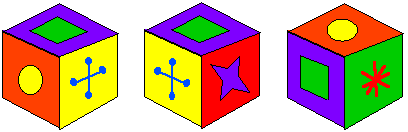
Here are the six faces of a cube - in no particular order:
Here are three views of the cube:
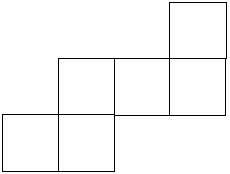
Can you deduce where the faces are in relation to each other and record them on the net of this cube?
You can use this interactivity to try out your ideas. You will still have to visualise the cube folded up!
This text is usually replaced by the Flash movie.
Why do this problem?
This problem is a little more difficult than it looks. It requires children to visualise the adjoining faces of the cube and transfer this to a net of the cube.
Possible approach
You could start by showing the group the problem on an interactive whiteboard or data projector. When you have discussed it and what needs to be done children could work in pairs so that they are able to talk through their ideas with a partner. They could use a print out of
this sheet or draw the faces of the cube for themselves. Scissors and
sticky tape would be useful!
When they have built the cube they should then transfer it to a net. This can be any arrangement which can be folded into a cube not necessarily just the conventional cross given on the sheet. At the end of the lesson, the children could show the whole group both their cubes and the nets they have drawn. The class' work would make a great display, along with a copy of the challenge
itself.
This sheet gives larger coloured faces of the cube which can be made from card or stuck onto six square "Polydron" pieces so the puzzle can be done again and again.
Key questions
Why do you think these two faces are next to each other on the cube?
Look at these two faces. Which other one goes near them?
Possible extension
Those who found this task straightforward could try to make the net of the octahedron from this sheet .
Possible support
Suggest making a net from this sheet and leaving it so it can be folded and unfolded. Then draw or paste on the faces one by one. If "Polydron" squares are available the cube can be built up using the pieces from this sheet .