Abundant Numbers
Georgia, from Holy Trinity School, found two
more abundant numbers:
$36$: total is $55$ ($1+2+3+4+6+9+12+18$)
$70$: total is $74$ ($1+2+5+7+10+14+35$)
Rachael, Jamie, Heledd, Sian, Dafydd,
Tom, Edward and Isaac from Ysgol Bryncrug clearly worked hard on
this problem. They told us:
We decided to find out which of the numbers from $1$ to $100$ are
abundant numbers.
We decided that prime numbers are not abundant numbers:
$2, 3, 5, 7, 11, 13, 17, 19, 23, 29, 31, 37, 41, 43, 47, 53, 59,
61, 67, 71, 73, 79, 83, 89, 97$
because without themselves $1$ is their only factor.
We crossed out all the prime numbers from our $100$ square:
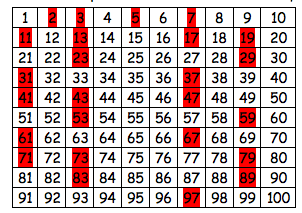
Then we looked at all the remaining numbers. Here is an
example:
$27 = 1\times27$, $3\times9$
So the factors of $27$ are:
$1, 3, 9, 27$
The sum of its factors without itself is:
$1+3+9 = 13$
$13$ is less than $27$
therefore $27$ is not an
abundant number
And another example:
$48 = 1\times48$, $2\times24$, $3\times16$, $4\times12$,
$6\times8$
So the factors of $48$ are:
$1, 2, 3, 4, 6, 8, 12, 16, 24, 48$.
The sum of its factors without itself is:
$1+2+3+4+6+8+12+16+24 = 76$
$76$ is greater than $48$
therefore $48$ is an
abundant number
Something different happened with $6$:
$6 = 1\times6$, $2\times3$
So the factors of $6$ are:
$1, 2, 3$ and $6$
The sum of its factors without itself is: $1+2+3 = 6$
$6$ is equal to $6$!!
This also happened with $28$:
$1+2+4+7+14 = 28$
Edward wanted to find out what we call a number where the sum of
its factors (without itself) is equal to the number. He asked his
Dad and he told him that it is called a PERFECT NUMBER.
He also found out that the next perfect number after $28$ is $496$.
Then $8128$!!
We continued marking the numbers on the $100$ square:
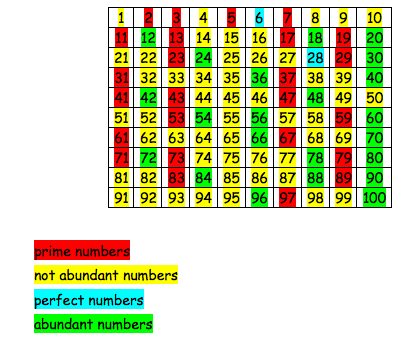
There are twenty two abundant numbers on our $100$
square.
Thank you for letting us know how you
approached this problem. I like the way you discovered
perfect numbers along the way. Well done!