|
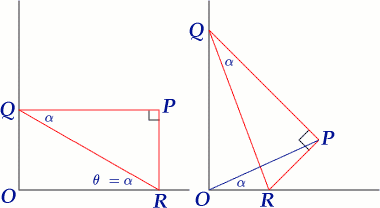
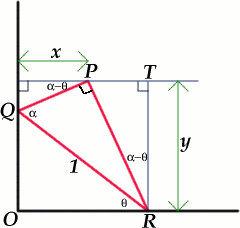
Sue Liu of Madras College, St Andrew's sent this solution to the problem. "Without loss of generality we can let the length of QR be 1 unit, and take a coordinate system with the origin at O and axes along OR and OQ. If ÐPQR = a, where 0 < a < 90°, then PQ = cosa and PR = sina. Let ÐQRO = q where 0 £ q £ 90°. Then, from the right angled triangles PSQ and PTR, we have ÐPRT = ÐQPS = a- q, and hence we can write down the coordinates of the point P. |
|
|
|