Sue Liu of Madras College, St Andrew's sent the solution to this
problem. The locus of the point P is a straight line as the vertex Q of
the right angled triangle PQR slides up the wall and the vertex R slides
towards the corner.
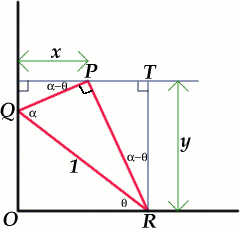
Without loss of generality we can let the length of QR be 1 unit, and take
a coordinate system with the origin at O and axes along OR and OQ.
If ∠PQR = α, where 0 < α < 90°, then PQ = cos α
and PR = sin α.
Let ∠QRO = θ where 0 ≤ θ ≤ 90°. Then, from the
right angled triangles PSQ and PTR, we have
∠PRT = ∠QPS = α− θ,
and hence we can write down the coordinates of the point P.
x
=
cos α cos(α − θ)
y
=
sin α cos(α − θ).
We see that
y
x
=
sin α cos(α − θ)
cos α cos(α − θ)
= tan α.
and so P lies on the straight line y = xtan α.
The position (x,y) depends only on cos(α − θ), α being a
constant, and θ a variable. The distance of the point P from O is
given by
Hence
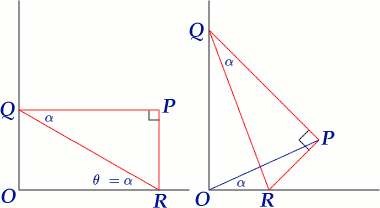
OP = cos(α − θ) which is a maximum when cos(α − θ) = 1, that is when α = θ. This occurs when OQPR is a rectangle as
shown in the diagram.
We get an even simpler method of solution by using the fact that the angles
QOR and QPR are both 90 degrees so that OQPR is a cyclic quadrilateral
with PR as a chord. We have ∠POR = ∠PQR = α because
these two angles are subtended by the same chord of the circle. This shows that
∠POR is constant and hence that the locus of P is the straight line
y = x tan α.
What can you say about the locus of P if the triangle PQR is not a right
angled triangle?