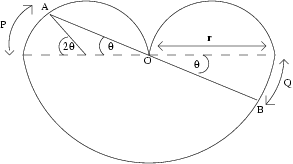
We shall prove that the line AOB always divides the total perimeter into two
equal parts, both of length
, defining
to be the radius of the large
semicircle as in the diagram.
First consider the case where the line AOB is horizontal. The perimeter of the
bottom half (the large semicircle) is
. Twice the perimeter of each
of the small upper semicircles is
, again
. Hence
when the line AOB is horizontal, the section of the perimeter above the line
and the section below the line are of equal length.
As the line AOB rotates about O, the lengths of the two sections of the perimeter change to
on one side of the line and
on the other (where
and
are lengths as defined in the diagram above).