Tom sent in the following neat solution
that uses some of the ideas suggested in the hints. He noticed
that the symmetry means you only need 'half' the diagram and
that two radii joining the centres of the circles to the
tangents created useful pairs of similar triangles.
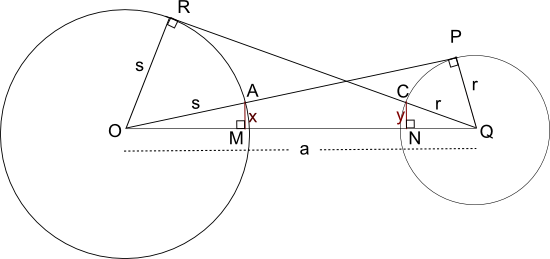
First I noticied that, if I drew in the radii there were
similar triangles to work with.
Triangle $ ORQ $ is similar to triangle $CNQ$
This means that, using the ratio of matching sides:
$$\frac{s}{a} = \frac{y}{r}$$ $$y = \frac {sr}{a}$$
Triangle $QPO$ is similar to trangle $AMO$
This means that, using the ratio of matching sides: $$
\frac{r}{a}= \frac{x}{s} $$ $$
x = \frac{sr}{a}$$
So $ x = y$.
Sue Liu of Madras College also sent a good
solution to this problem.
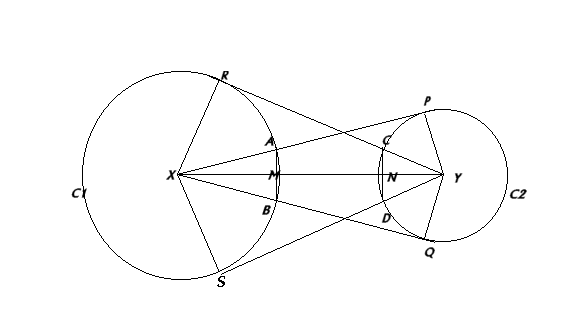
Conjecture: $AB = CD$
Proof
We start with Sue's proof that $XY$ is the
axis of symmetry of the whole shape.
$XP = XQ$ because they are two tangents from one external
point.
$\angle XPY = \angle XQY = 90^{\circ}$.
$YP = YQ = r$ so $PYQX$ is a kite and $XY$ is the axis of
symmetry of $PYQX$.
Similarly
$YR = YS$ because they are two tangents from one external
point.
$\angle YRX = \angle YSX = 90^{\circ}$.
$XR = XS = R$ so $RXSY$ is a kite and $XY$ is the axis of
symmetry of $RXSY$.
Therefore $XY$ is the axis of symmetry of the whole shape.
Sue then goes on to prove in detail
that $ABDC$ is a rectangle. Her proof is an excellent piece of
work though a little longer than the proof below. The following
proof uses sines but it could equally well be written entirely
in terms of similar triangles.
The radii of the two circles $C1$ and $C2$ are given by:
$XR = XA = R$
$ YP = YC = r$.
Let $M$ and $N$ be the midpoints of the chords $AB$ and $CD$.
Note that $M$ and $N$ are on the line $XY$ joining the centres
of the circles and the angles $AMX$ and $CNY$ are right angles.
As $XP$ is a tangent to the circle with centre $Y$, angle $XPY$
is a right angle.
From the right angled triangles $AXM$ and $YXP$
$$\sin\left(\angle AXM\right) = \frac{AM}{R} = \frac{r}{XY}
\qquad \qquad (1)$$
Similarly $YR$ is a tangent to the circle with centre $X$ and
angle $YRX$ is a right angle.
From the right angled triangles $CYN$ and $XYR$
$$\sin\left(\angle CYN\right) = \frac{CN}{r} = \frac{R}{XY}
\qquad \qquad (2)$$ From equations (1) and (2) we have $$AM =
CN = \frac{rR}{XY}$$ Hence $AB = CD$.