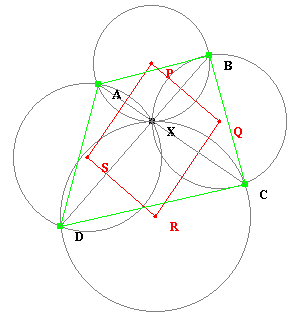
Thank you to Mayank, Campion School, Bhopal, India; Yung, from Hong Kong and Ruth from Manchester High School for Girls for your solutions. Here is Ruth's solution:
Chi Kin, St Dominic's International School of Lisbon, also gave an excellent proof including a discussion of the degenerate cases where one vertex, A, B, C or D is moved on top of another or on top of the point X. In these cases there is no longer a convex quadrilateral ABCD.
For instance, if we move C on top of B, both the points B, C and X are joined at one point. As a result, the circumcircle of the triangle BXC is reduced to a point, and only 3 circles will be left. Quadrilateral PQRS cannot be formed any more.
Consider also, as we move C on top of X, the common chord CX will be eventually reduced to a point, and RQ will therefore disappear. Quadrilateral PQRS can't be formed.
Finally, if we move C on top of A, two of the circles will be overlapping the other two. As a result, RQ will also overlap PS, and the quadrilateral PQRS is reduced to a line.