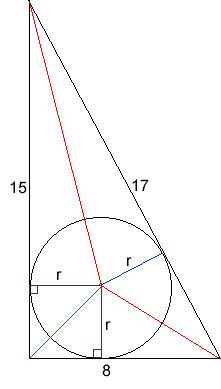
There were a number of correct answers but few correct solutionsthat explained why the radius of the circle was 3 and also generalised the solution to any right-angled triangle. The best of these came from Robert of King Edward VI Grammar School. Well done Robert.
Those of you who sent in answers please remember that answers are not enough - we want you to explain why.
Looking at the triangle with side lengths 8, 15 and 17, we can find it is right-angled (as
82 + 152 = 172 ).If we inscribe a circle in this triangle, we can split the
triangle into 3 component pieces, each with the circle's radius
as the height of that smaller triangle and a side length as the
base. As the area of the three smaller triangles added together
equals the area of the large triangle,
(r is the radius of the circle)
8r/2 + 15r/2 + 17r/2 = 8*15/2.
Multiplying by 2:
8r + 15r + 17r = 8*15
40r = 120
r = 3
This method can be extended to any right-angled triangle ABC. Merely split it into 3 triangles with the circle's radius as the height and a side length as the base, and then use the same method:
(r is the radius of the circle and a,b,c the side lengths of
the large triangle and c is the hypotenuse)
ar/2 + br/2 + cr/2 = ab/2
ar + br + cr = ab
r(a+b+c) = ab
r = ab/(a+b+c)
Therefore the radius of the circle is the product of the two side lengths (those besides the hypotenuse) divided by the sum of all 3 side lengths.