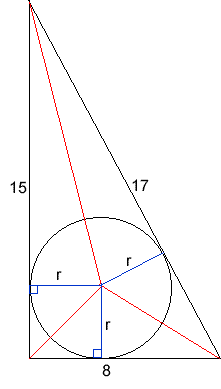
Those of you who sent in answers please remember that answers are not enough - we want you to explain why.
Looking at the triangle with side lengths $8, 15$ and $17$, we can find it is right-angled (as $ 8^2 + 15^2 = 17^2$).
If we inscribe a circle in this triangle, we can split the
triangle into $3$ component pieces, each with the circle's radius
as the height of that smaller triangle and a side length as the
base. As the area of the three smaller triangles added together
equals the area of the large triangle, ($r$ is the radius of the
circle)
$$8\frac{r}{2} + 15\frac{r}{2} + 17\frac{r}{2} = 8\times
\frac{15}{2}$$
Multiplying by $2$:
$8r + 15r + 17r = 8\times 15$
$40r = 120$
$r = 3$
This method can be extended to any right-angled triangle $ABC$. Merely split it into $3$ triangles with the circle's radius as the height and a side length as the base, and then use the same method:
($r$ is the radius of the circle and $a$,$b$,$c$ the side
lengths of the large triangle and $c$ is the hypotenuse)
$$a\frac{r}{2} + b\frac{r}{2} + c\frac{r}{2}=
\frac{ab}{2}$$
$$ar + br + cr = ab$$
$$r(a+b+c) = ab$$
$$r = \frac{ab}{a+b+c}$$
Therefore the radius of the circle is the product of the two side lengths (those besides the hypotenuse) divided by the sum of all $3$ side lengths.