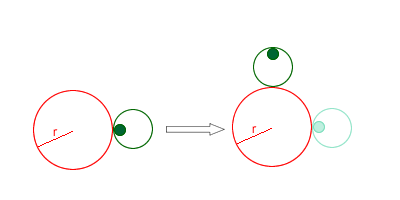
The moving coin makes two complete revolutions in a full turn. You could consider this in one of the following ways:
Begin with the moving circle to the right of the fixed circle and rolling anti-clockwise. Start rolling the circle and stop when it has moved one quarter of the way around the first circle (it is now at the “top” of the fixed circle). The moving circle has the same circumference as the fixed circle so when it has rolled around a quarter of the fixed circle it will have rolled along a quarter of its circumference, that is it would have completed a quarter turn. In addition it has been given a quarter turn by the curvature of the fixed circle, making a total of ½ of a turn. If the circle is rolled all the way around the fixed circle this makes a total of 4 x ½ turn, which is 2 full turns.
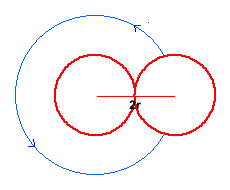
Alternatively, when the moving coin has traveled all around the inner circle, the centre of the outer circle will trace a circular path with a radius of r+r (i.e. the sum of the two radii). The centre will therefore have covered a distance of .
For the centre of the circle to cover a distance of it would have to rotate twice. If you are having trouble visualising this – imagine you are on a bicycle with wheels of radius r. For the cycle to move a distance of its wheels will have to rotate twice.
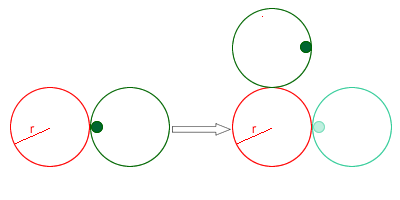
Start with the moving circle to the right of the fixed circle. Again consider when the moving circle is directly above the fixed one. The smaller circle has half the radius and therefore half the circumference of the fixed circle so when it has rolled around a quarter of the fixed circle it will have rolled along half its circumference, that is, it would have completed half a turn. In addition it has been given a quarter turn by the curvature of the fixed circle, making a total of ¾ of a turn. If the small circle is rolled all the way around the fixed circle this makes a total of 4 x ¾ turns, which is 3 turns.
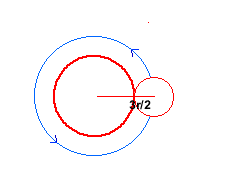
Using the distance travelled by the centre method:
The radius of the circle drawn by the centre of the moving circle is 1.5r. So the distance travelled by the centre is 2 x1.5 r x . = 3
The circumference of the small circle is pr so this means it will have completed 3 turns.
General rule:
Radius of fixed circle: r
Radius of outer circle n.
Centre of moving circle will trace a circular path of radius r+n
Total distance = 2 (r+n)
Circumference of moving circle = 2 n
No. of revolutions is 2 (r+n)/ 2 n = 1 + r/n revolutions.