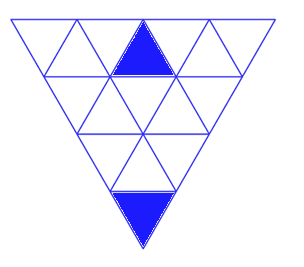
Neil sent in this solution. It's not
quite right, but it makes a good start.
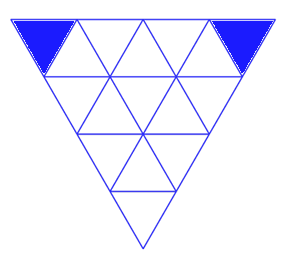
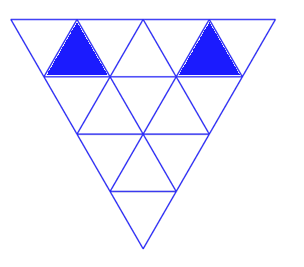
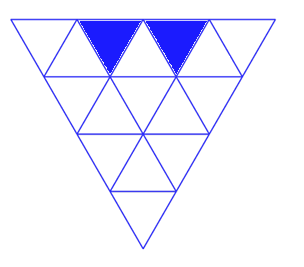
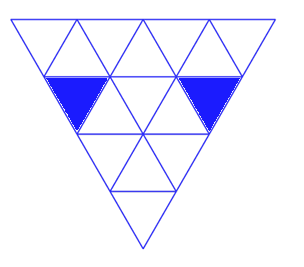
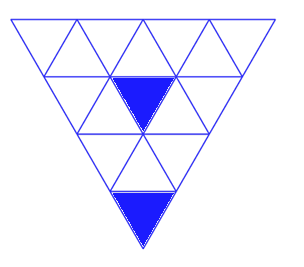
There are 12 different "symmetrical pairs" in the big triangle
(shown below), and 2 different pairs must be used on each
pattern. So pair number 1 can go with any one of pairs 2 through
to 12. This gives us 11 patterns. Continuing in the same
way:
1 goes with 2 through to 12 making 11 patterns.
2 goes with 3 through to 12 making 10 patterns.
3 goes with 4 through to 12 making 9 patterns.
...up until...
11 goes with 12 through to 12 making 1 pattern.
We need to add all integers 1 to 11, for which we can use the
formula:
(112+11)/2=(121+11)/2 = 132/2 = 66
So the answer is 66 patterns.
In fact, this isn't quite right, because
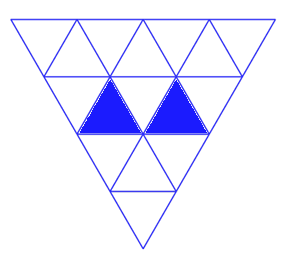
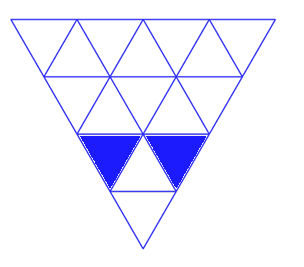
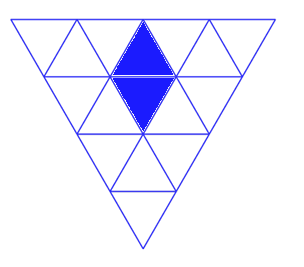
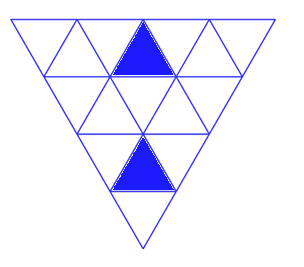
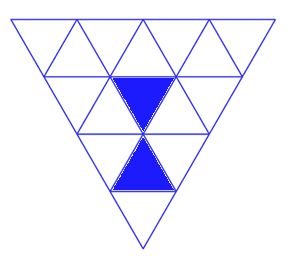
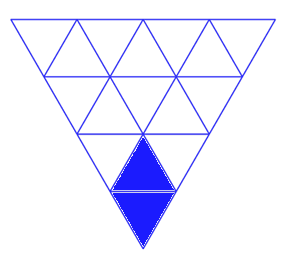
not all of the pairs can go together. For example, we can't
combine both pairs shown in the fourth row below. So there aren't
quite as many as 66.
Taking this into account we can use
Neil's approach and work out that there are 11+10+9+8+7+6+1=52
possibilities.
Mary sent us her work:
Think about the four little triangles in a vertical line in the
middle of the triangle. We must have an even number of them in
our pattern. We can count the different possibilities separately.
All four of the vertical
ones: 1 possibility (we don't need to colour in any more
triangles).
Two of the vertical ones:
there are 6 possible pairs that don't include the middle ones,
each of which can go with any of the 6 vertical pairs, so there
are 6x6=36 possibilities.
None of the vertical
ones: there are 6 pairs that don't include the middle
ones. Once we've picked one of them, there are 5 others left to
choose from. But this counts every possibility twice (A with B
and B with A), so there are 6x5/2=15 possibilities.
So there are 1+36+15=52 total possible patterns.
Below are the twelve symmetrical
pairs.