There are many possible questions to think about in this problem. A systematic approach is important to avoid counting the same patterns twice, or missing any out!
Melissa and Damian looked at the isometric grids, counting patterns with 1, 2, 3, and 4 shaded little triangles. It's important to decide what a different pattern means, for example if you shade the top little triangle at the vertex, and the left-most little triangle at the left vertex, are these different patterns? We'll consider these as the
same since they differ only by rotating the picture.
Shading 1 little triangle: No matter which you shade there is exactly one line of reflective symmetry. There are only 3 patterns, because any other can be rotated to look like one of these:
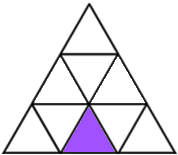
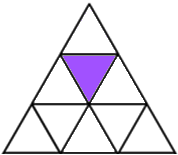
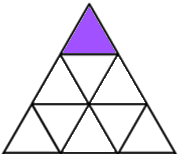
3 ways with 1 triangle shaded.
Shading 2 little triangles: To get a line of symmetry you need to choose carefully. To avoid counting patterns which look the same after a rotation we'll just look at the vertical line of symmetry. You can choose two of the triangles on the vertical line in the middle (three ways to do this) or one of the left-hand triangles with it's partner on the right (also three ways to do
this).
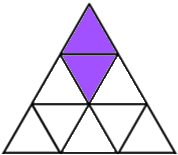
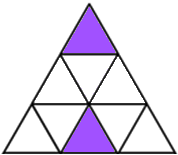
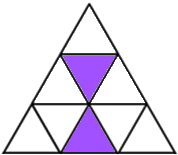
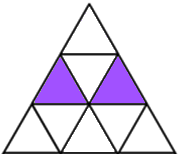
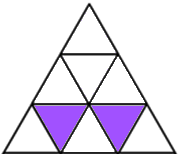
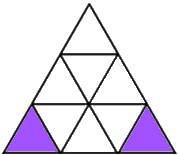
6 ways with 2 triangles shaded.
Shading 3 little triangles: Again just look at the vertical line of symmetry. Either take all 3 central triangles, or take just 1 and a symmetrical pair of other ones.
There only 1 way of shading all 3 central triangles:
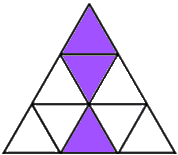
And 3 ways of taking one of those central ones, with three possible left-right pairs to add to it to make a pattern with 3 shaded little triangles.
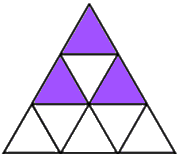
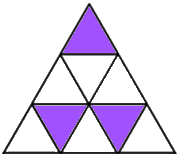
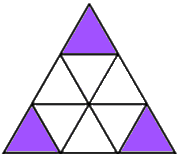
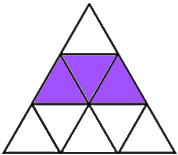
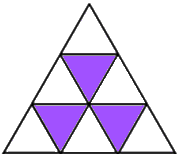
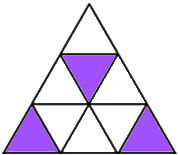
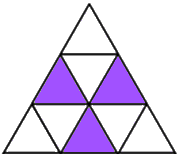
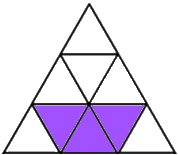
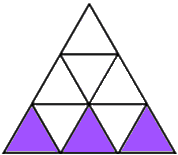
This makes 1 + 3x3 = 10 ways with 3 triangles shaded.
You might like to try this method on shading 4 and 5 little triangles.
Shading 6 little triangles: There are 9 triangles in total so when 6 are shaded that leaves 3 unshaded. Can you see that with 6 shaded symmetrically, the remaining 3 are also arranged symmetrically? The same is true when shading 3 triangles, the remaining 6 are also arranged symmetrically. That means that each pattern we found with 3 shaded triangles gives rise to exactly 1
pattern with 6 shaded triangles. Think of swapping the purple and white colours in the pictures above!
This means there are also 10 patterns with a line of symmetry when shading 6 of the triangles.
More lines of symmetry: Notice that the patterns with 1 and 2 shaded triangles always have only 1 line of symmetry. Some of the patterns with 3 shaded triangles have 3 lines of symmetry and rotational symmetry.
Can you find any patterns with exactly 2 lines of symmetry? If so, how? If not, why not?
Christian investigated the square grid and found many patterns like the ones below. Notice that we can use a similar method for finding patterns exploiting symmetry. Things seem a bit more complicated with the square though...
Shading 1 little square: The square has two distinct types of reflectional symmetry; in diagonal and in side-bisecting lines. No amount of rotating the square makes these symmetries look the same. Like with the isometric grid, there are 3 ways of shading 1 square:
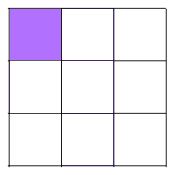
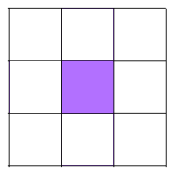
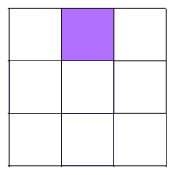
Shading 2 little squares: We'll need to shade two squares along a line of symmetry or a pair either side of a line of symmetry. Remember the diagonal and the side-bisecting lines! Be careful not to double count some patterns because opposite corners can be made to look the same by 180 degree rotations!
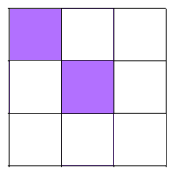
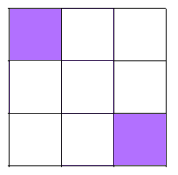
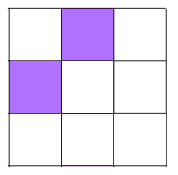
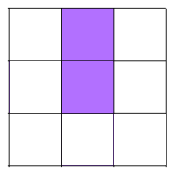
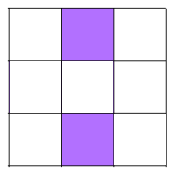
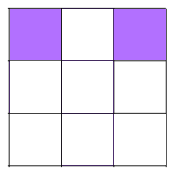
There are 6 different patterns with 2 shaded squares.
Shading 3 little squares: Use the same method as before - work systematically along and either side of lines of symmetry.
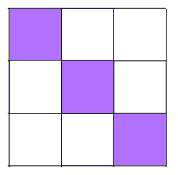
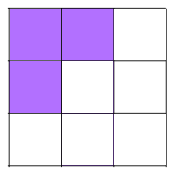
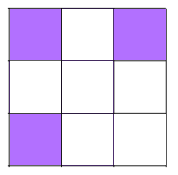
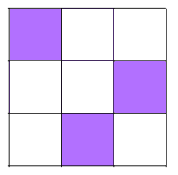
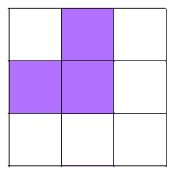
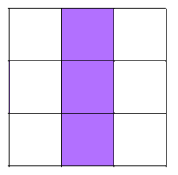
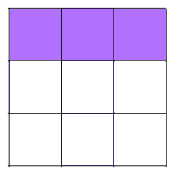
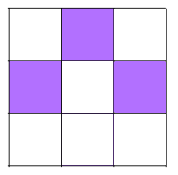
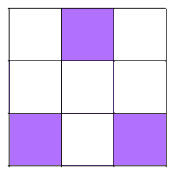
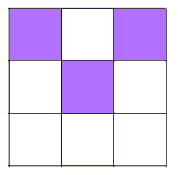
There are 10 different patterns with 3 shaded squares.
Do you notice anything similar to the isometric case? What about 4, 5, 6, 7 or 8 shaded squares? Do you need to do any more work?
There are many more questions that you could ask about these patterns. Have fun investigating further.