This question is about the number of ways of
combining an ordered list of terms by repeating a
single binary operation.
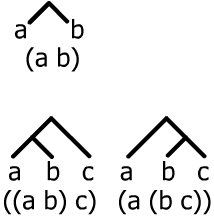
For example with three terms a, b and c there are just two ways
((aÅb)Åc) and (aÅ(bÅ c)). Suppose the binary operation Å is
just ordinary subtraction and a=12, b=7, c=5
then ((aÅb)Åc) = 5 - 5 = 0 and
(aÅ(bÅc)) = 12 - 2 = 10.
We are not
concerned in this question with doing the
'arithmetic' or with whether the answers are the
same or different. We just want to find out how
many ways there are of combining the terms, or if
you like of putting brackets into the expression.
Note that we need the brackets because the answers may
be different as in the subtraction example.
These two tree diagrams show the two cases for
combining 3 terms.
"
Show that for four terms, (three binary
operations) there are five cases and find the
number of cases for five terms and six terms.
See also the problems
One Basket and
Walkabout