Well done Robert Goudie of Madras College, St Andrew's, Scotland
and Andrei Lazanu of School No. 205, Bucharest, Romania for your
solutions to this problem.
In both parts of this question we consider the limiting case of a process which is repeated infinitely
often and things are not what they might seem to be.
(a) In a square ABCD with sides of length 1 unit a path is drawn from A to the opposite corner C so
that all the steps in the path are either parallel to AB or parallel to BC and not necessarily equal
steps. If we draw paths of this sort putting in more and more and more steps the length of the path is
always the same.
"
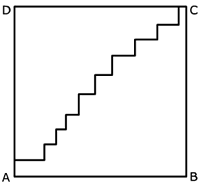 The steps parallel to AB together must stretch all the way across from A to B and the steps
parallel to BC together must stretch all the way up from A to D. Irrespective of the number of
small steps, A point moving on any path of this type moves a total of 1 unit parallel to AB and a
total of one unit parallel to BC, hence a total of 2 units altogether. With more and more steps the
path gets closer and closer to the diagonal so you might expect the length to converge to Ö2.
Surprisingly the length is always 2 units and not even close to Ö2 units.
The steps parallel to AB together must stretch all the way across from A to B and the steps
parallel to BC together must stretch all the way up from A to D. Irrespective of the number of
small steps, A point moving on any path of this type moves a total of 1 unit parallel to AB and a
total of one unit parallel to BC, hence a total of 2 units altogether. With more and more steps the
path gets closer and closer to the diagonal so you might expect the length to converge to Ö2.
Surprisingly the length is always 2 units and not even close to Ö2 units.
(b) Now consider the graphs of
for n = 1,2,3, ... and 0 £ x £ 2p. As n
tends to infinity the graphs oscillate more and more and get closer and closer to the x axis. We have to prove
that the length of the curve from x=0 to x=2 p is the same for all values of n. The hint says we don't
need to calculate the length of the path here and we should think about scale factors.
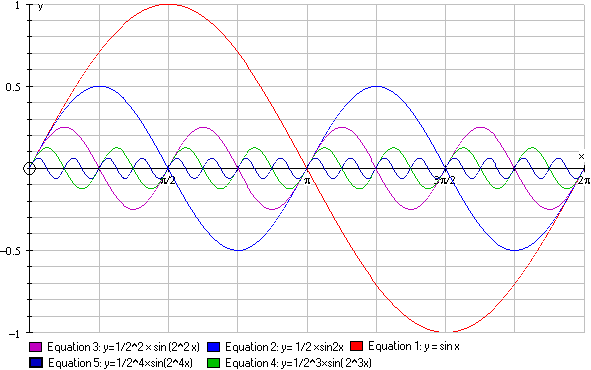 The graph of
from x=0 to x=p is similar to the
graph of
from x=0 to x=2p but scaled down by a linear scale
factor of 1/2 so Gn is half the length of Gn-1. However Gn is repeated twice periodically between x=0
and x=2p so the two pieces together have the same length as Gn-1 .
This shows that all these graphs on 0 £ x £ 2p have the same length although as n® ¥
the graphs get closer and closer to the x axis so you might suppose that the length converges to 2p.
Surprisingly the length is always the same and much more than 2p.