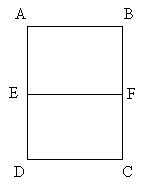
1. The ratio of the lengths of A4 paper is v2 to 1. So, let the side of an A4 paper have lengths x and xv2.
Continuing is the same manner, I observe that the smaller and the bigger A-paper all have the same proportions of length.
2. The angles of a regular pentagon must all
be 108°.
a) First I looked at the possibility of working
with A4 paper.
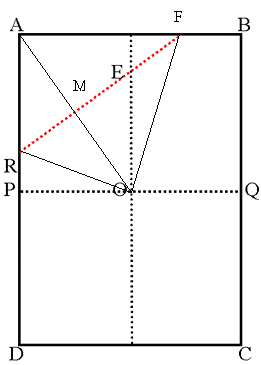
In the problem, I have to put A over O. So, triangles ARF and ORF are congruent, AM = MO and AO is perpendicular on FR.
As before, I note the smaller side of the paper (AB), with length x. Consequently, AD is .b) Now I have to calculate the new dimensions of the paper, so that I obtain a regular pentagon.
To make a regular pentagon in this way the ratio of the side lengths of the paper would have to be equal to tan 540 , that is in the ratio 1.376 to 1 (to 4 significant figures) rather than 1.414 to 1 as in A4 paper.
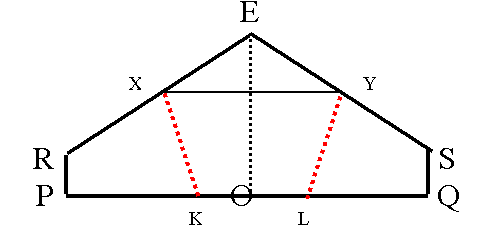
In the figure angle RES has a measure of 108°, XY is parallel to PQ and XK and YL are angle bisectors of angles RXY and SYX respectively.
Angles EXY and EYX are both equal to 36°. Consequently angles RXY and XYS both have a measure of 144°. Now, I calculate angle KXY:
KXY = RXY/2 = 72°
Now, I calculate angles EXK and EYL (the angles of the pentagon):
EXK = EYL = 72° + 36° = 108°
I observe that the other two remaining angles are also congruent (by symmetry), both having a measure of 108°.
So, I proved that in this case I obtain a regular pentagon.